
MOTS-c Australia: A Researcher's Reference Guide
A question sits underneath much of the online discussion about MOTS-c Australia: are researchers evaluating a defined mitochondrial signalling reagent, or are they being asked to accept therapeutic conclusions that the evidence cannot yet support?
For an Australian laboratory, the answer starts with identity, not marketing. MOTS-c is a 16-amino-acid mitochondrial-derived peptide used in research relating to mitochondrial signalling, metabolic regulation and cellular stress. It remains a research-use-only material, not an approved therapy, and procurement decisions should rest on study design, documentation, traceability and institutional compliance.
Table of Contents
- What MOTS-c Is and Why Australian Labs Are Paying Attention
- The Australian Research Context for MOTS-c
- Where the MOTS-c Evidence Is Strongest and Where It Stops
- Laboratory Handling and Reconstitution Considerations
- Verifying MOTS-c Quality Through Documentation
- Procurement Pathways and Domestic Shipping in Australia
- Compliance, Legality, and Research-Use-Only Positioning
What MOTS-c Is and Why Australian Labs Are Paying Attention
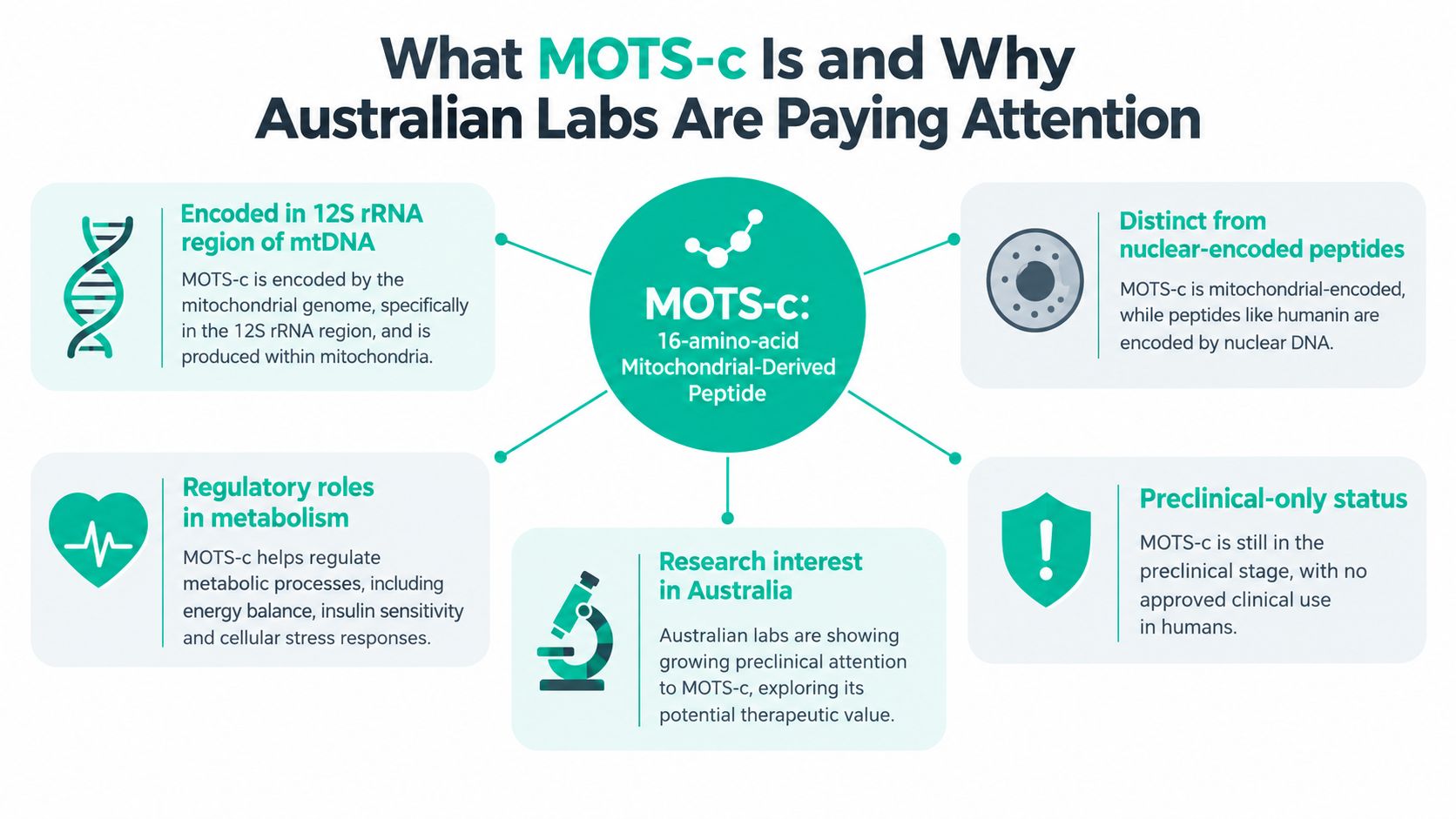
MOTS-c is encoded within the 12S rRNA region of mitochondrial DNA. That origin distinguishes it from peptides encoded by nuclear DNA. The distinction matters because mitochondrial-derived peptides sit within a research area that connects mitochondrial genetics, cellular energy regulation and stress-response biology.
Researchers have investigated MOTS-c as a signalling molecule associated with cellular energy homeostasis, metabolic stress responses and pathways that include AMPK-related activity. These mechanisms provide a reason to study the peptide in cell, animal and exercise-physiology models. They don't, by themselves, demonstrate that MOTS-c treats a disease or produces a validated therapeutic outcome in humans.
Australian research-oriented product information commonly presents MOTS-c through this metabolic and mitochondrial lens, referring to the original 2015 cell-metabolism work and later mouse and human-exercise literature as the main evidence base. That description is useful for scoping a reagent, but it shouldn't be read as evidence of an approved clinical indication. Australian MOTS-c research information also reinforces the distinction between experimental interest and human use.
Start with the identity record
Before a lab compares suppliers, the principal investigator or laboratory manager should define what the study requires:
- Molecular identity: MOTS-c, a mitochondrial-derived peptide encoded in the 12S rRNA region of mitochondrial DNA.
- Research context: cellular metabolism, mitochondrial signalling, stress-response biology or exercise-related investigation.
- Study system: in-vitro, ex-vivo, animal or analytical work.
- Documentation threshold: batch-specific identity and purity evidence, storage information and traceability records.
- Regulatory boundary: laboratory research only, with no assumption of therapeutic, diagnostic or human-consumption use.
MOTS-c should therefore be treated as a research input whose suitability depends on the experiment and its documentation. A catalogue description can help identify the material, but it can't replace a batch review, method assessment or institutional approval process.
Practical rule: Define the experiment and evidence standard before you define the pack size.
Products are supplied strictly for laboratory research purposes only. They are not for human consumption, therapeutic use or diagnostic procedures.
The Australian Research Context for MOTS-c
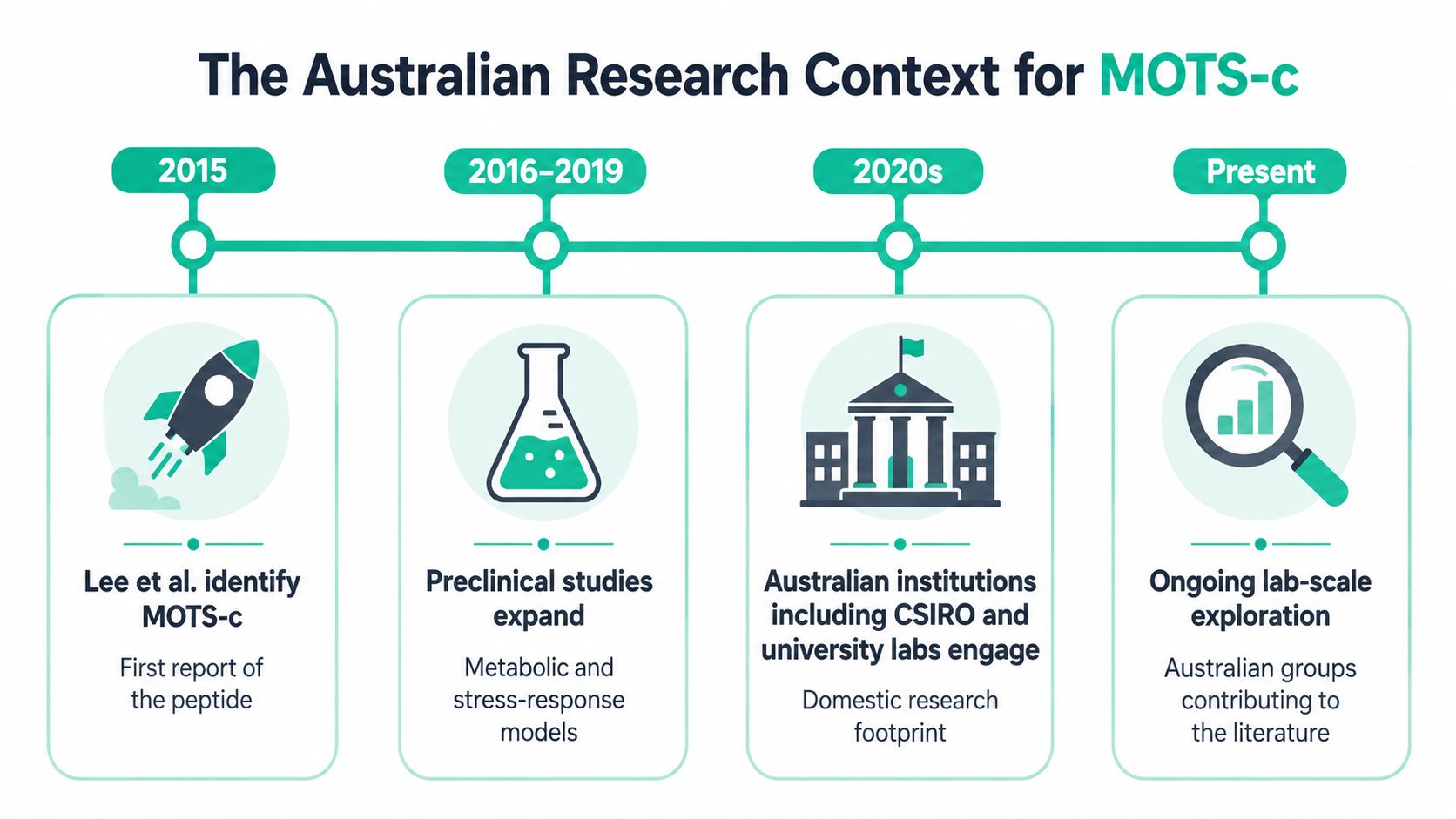
MOTS-c sits within a broader Australian life-sciences environment rather than an isolated online market. In 2024, Australian higher-education organisations spent A$16.404 billion on R&D, with 44% concentrated in biomedical and clinical sciences, health sciences and biological sciences. Higher-education R&D also rose 17% from 2022 to 2024 in current-price terms, while HERD increased from 0.54% to 0.59% of GDP over the same period. These figures point to a substantial institutional base for laboratories that need documented, repeatable research inputs. Australia's life-sciences capability and R&D context
The country also has a long peptide-science lineage. The Australian Peptide Association records that Australian peptide science began at CSIRO in 1940, developed into the Biochemistry Section two years later, and reached another milestone when the first dedicated peptide research laboratory at CSIRO was established in 1956. The association itself was formally established in 1983.
That history supports a sensible conclusion, but not an exaggerated one. Australia has capabilities and researchers able to contribute to peptide characterisation and application studies. It doesn't follow that Australia discovered every peptide of current interest, or that domestic research activity converts a preclinical compound into an approved medicine.
From field history to present-day procurement
The Australian health and medical research ecosystem remains active. Between 2006 and 2020, more than 18,000 clinical trials recruiting participants in Australia were registered, with 40% occurring from 2016 to 2020. Of those trials, 69% were Australia-only and 31% multinational. This context helps explain why Australian universities, hospitals, CROs and biotechnology groups often require unusually careful receiving records and study documentation, even when a material is being used only in an early-stage laboratory project. Australian health and medical research workforce evidence
MOTS-c belongs in that infrastructure as a research subject, not as a clinical product. Australian groups can investigate mitochondrial biology, metabolism and related questions while still applying conservative language to findings. The important boundary is between participating in characterisation or application research and claiming that a compound is ready for therapeutic use.
Where the MOTS-c Evidence Is Strongest and Where It Stops
The most useful way to read MOTS-c literature is as an evidence gradient. A cell assay can support a mechanistic observation. An animal study can test a physiological hypothesis in a controlled model. Neither automatically supports a clinical claim.
Research-oriented Australian material describes MOTS-c through metabolic, mitochondrial-signalling and cellular-stress studies. The evidence base includes cell and animal work, alongside human exercise-related research that examines circulating MOTS-c or acute metabolic responses. Those categories answer different questions, so they shouldn't be combined into a single statement about efficacy.
Match the study question to the evidence
A laboratory studying receptor binding, mitochondrial function or stress-response signalling can frame MOTS-c as an experimental perturbation. A group studying exercise physiology can investigate associations between exercise conditions, circulating peptide measurements and acute metabolic responses. In both cases, the protocol should identify whether the endpoint is biochemical, cellular, physiological or clinical.
| Study type | Evidence strength | Typical findings | Researcher caveat |
|---|---|---|---|
| In-vitro cell studies | Useful for mechanism and assay development | Cellular signalling, metabolic responses or stress-related readouts | Cell concentration, timing and model choice limit external interpretation |
| Animal studies | Useful for controlled physiological modelling | Metabolic or mitochondrial responses in a defined organism | Rodent findings don't establish human benefit, safety or clinical dosing |
| Human exercise-physiology studies | Relevant to translational observation | Circulating MOTS-c measurements and acute exercise-related responses | Association or acute response isn't proof of therapeutic action |
| Long-term human outcomes | Limited as a basis for treatment claims | The field is still developing | Don't infer durable clinical benefit from preclinical or short-term findings |
| Disease-treatment claims | Not established by the available research framing | Mechanistic plausibility may motivate further work | A plausible pathway isn't an approved indication or demonstrated treatment |
The practical consequence is straightforward. A study can be scientifically worthwhile without promising a therapeutic result. Researchers should write that MOTS-c has been investigated, that a model showed a measured response, or that findings support further study. They shouldn't present animal outcomes as evidence that the peptide treats obesity, diabetes, ageing or another disease.
A clean research question is narrower than a marketing claim, and that's a strength rather than a limitation.
A protocol that measures a defined metabolic or mitochondrial endpoint may be defensible when its controls and analytical methods are clear. A protocol that begins with a chronic-disease intervention claim needs much stronger evidence than a cell experiment can provide. Australian clinical settings also introduce ethical, regulatory and operational requirements that a rodent model can't answer.
Laboratory Handling and Reconstitution Considerations
Handling begins with the vial and its documentation. Australian product listings commonly describe MOTS-c in 10 mg lyophilised research formats, with some listings reporting at least 99% HPLC purity and identity verification by HPLC and mass spectrometry. Those are listing-level claims, so the receiving laboratory should assess the documentation for the actual batch rather than generalise a result across all material. An Australian MOTS-c listing with format and testing information
Keep the lyophilised material protected from moisture and temperature excursions. A laboratory should follow the supplier's stated storage conditions, check whether a desiccant is present, allow a cold vial to equilibrate before opening where condensation could be a concern, and record the condition of the seal and label at receipt.
Use the calculation, not guesswork
For neutral laboratory mathematics, the basic relationship is:
concentration = mass ÷ volume
If a vial contains a known mass in milligrams and the laboratory adds a measured volume in millilitres, the resulting stock concentration is expressed in mg/mL. Converting that value to molarity requires the batch's stated molecular mass, the unit conversion from grams to milligrams, and the volume in litres. MOTS-c is commonly described as having a molecular mass near 2,174 g/mol in research documentation, but the certificate should be checked for the stated form and counter-ion before calculations are entered into a protocol.
Solvent selection belongs to the assay, not to a generic internet protocol. A sterile aqueous solvent may suit one workflow, while dilute acetic acid may be considered where the peptide's solubility and the downstream assay's pH tolerance require it. The counter-ion can affect observed behaviour, so acetate and other forms shouldn't be treated as interchangeable without checking the certificate and method notes.
Aliquoting and records
Dissolve material gently according to the laboratory's validated procedure. Avoid vigorous handling where it could introduce foaming or unnecessary stress, then prepare labelled aliquots that reduce repeated freeze-thaw exposure. Each aliquot record should connect the vial identifier, calculated concentration, solvent, preparation date, operator and storage location.
For a neutral bench reference, use the guide to reconstituting research peptides alongside the relevant batch documentation. It should supplement, not replace, the laboratory's own risk assessment and assay controls.
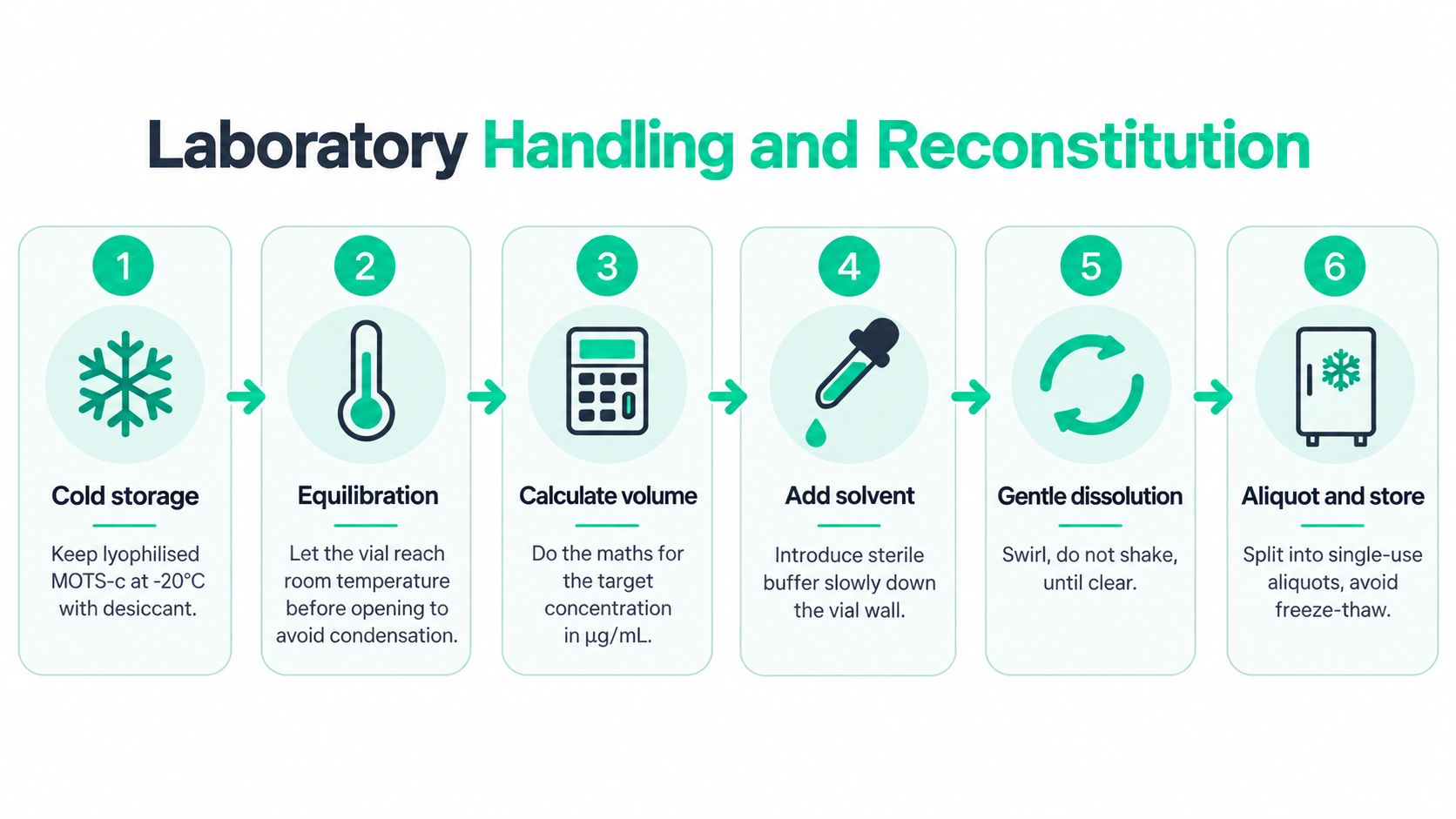
A visual laboratory reference can help standardise the sequence, but it doesn't authorise human administration or determine whether a preparation is suitable for an animal or cell study.
Verifying MOTS-c Quality Through Documentation
A certificate of analysis is a verification record, not a decoration attached to an invoice. The first question is whether the batch identifier on the certificate matches the vial or material received. The document should also connect the lot code to the dispatch record so the laboratory can reconstruct what arrived, when it arrived and which analytical evidence belongs to it. Batch-specific CoA and dispatch traceability principles
A stronger batch file connects the catalogue code, manufacturer lot, internal goods-in accession, analytical sample, result identifiers, certificate number and revision. That chain lets a university, CRO or biotechnology company reconcile purchasing records with analytical evidence and its internal quality system.
Robust versus thin documentation
| Documentation element | Robust file | Thin file |
|---|---|---|
| Batch identity | Lot number matches the vial, label and dispatch record | Generic certificate with no receiving match |
| Peptide identity | Method and result identify the expected material | Product name only |
| Purity | HPLC result with method reference and supporting chromatogram | Unexplained percentage without a traceable run |
| Mass confirmation | Mass-spectrometry result linked to the batch and method | Unlinked identity statement |
| Counter-ion | Counter-ion or material form is stated | Form is absent or ambiguous |
| Residuals and biological limits | Applicable residual-solvent, endotoxin or microbial information is identified | No explanation of what was or wasn't tested |
| Review status | Analyst sign-off, date, facility and document revision are present | Unsigned or undated PDF |
| Chain of custody | Shipping, receiving and storage records are retained | Certificate stored without shipment evidence |
The purity figure also needs context. Australian laboratory documentation should state whether the reported purity came from a purity run, a related-substances run, or both, and should identify the method ID used for each result. A chromatogram, peak table and system-suitability attachment are more useful when the laboratory can confirm that they belong to the same analytical procedure and date. Method-transparency criteria for peptide CoAs
A receiving checklist
Before material enters a study inventory, record:
- Identity: Catalogue code, lot, vial label and certificate agree.
- Analytical evidence: HPLC and mass-spectrometry records are linked to the batch.
- Method transparency: Method IDs, analysis dates, instrument or facility details and reviewer sign-off are available.
- Material form: Net peptide content and counter-ion are stated where relevant.
- Storage history: Dispatch, receipt, temperature and storage information are filed.
- Document control: Every PDF, revision and correspondence record sits with the internal study file.
A laboratory can then decide whether the evidence is manufacturer-provided, independently generated, pending or unavailable. Those categories shouldn't be blurred. Manufacturer documentation may be useful, but it isn't automatically equivalent to independent testing.
For a practical document review, use the MOTS-c CoA library and retain the relevant files with the batch record.
Procurement Pathways and Domestic Shipping in Australia
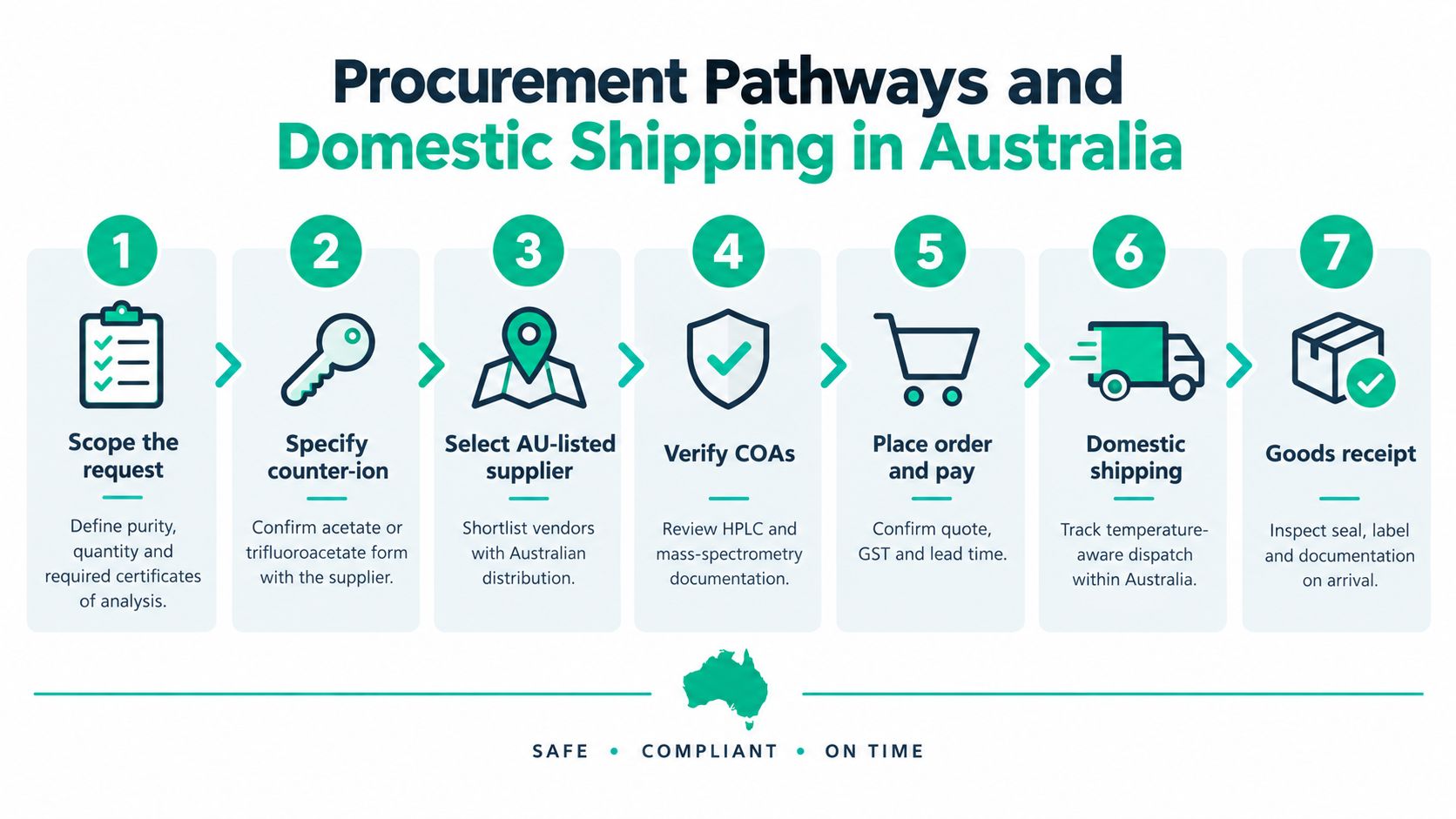
What must be settled before an Australian lab places an order for MOTS-c? Procurement should begin with the study requirements, not the supplier's catalogue. The requesting scientist should define the research system, quantity, material form, documentation threshold, and whether the work requires batch-specific identity, purity, or other analytical evidence. The material must remain designated for research use only.
A practical sourcing sequence
- Scope the request. Record the peptide identity, quantity, format, and certificates required by the laboratory.
- Confirm the material form. Ask the supplier to state the counter-ion and any relevant salt or acetate form.
- Compare supply routes. Australian-listed suppliers may make domestic receiving simpler. International suppliers can introduce import, customs, and documentation questions.
- Review evidence before ordering. Request the available CoA, method information, specification sheet, and stated storage conditions before approving the purchase.
- Confirm commercial details. Obtain the current AUD quote, GST treatment, pack format, lead time, and any institutional purchasing requirements.
- Record dispatch information. File the invoice, consignment or tracking record, and shipment correspondence with the batch record.
- Inspect on arrival. Check the seal, label, lot number, packaging condition, and accompanying documents before adding the material to study inventory.
The sequence works like a chain of custody. Each handoff should leave a record that links the requested material, the shipped lot, and the received vial.
Australian listings commonly present MOTS-c in standardised lyophilised formats, including 10 mg vials, and may describe domestic laboratory-use supply together with HPLC or mass-spectrometry verification. Availability, price, stock status, and delivery conditions can change. Procurement staff should confirm those details directly rather than rely on older catalogue information.
Shipping belongs in the audit trail
Domestic delivery does not end the procurement record. The receiving team should note whether the consignment required a signature, whether the outer packaging was intact, and whether the received lot matches the invoice and accompanying analytical documents. If the study specifies a storage condition, record any temperature-control information supplied by the vendor.
For repeat work, a purchase order can set standing requirements for batch documentation, lot traceability, and notification of substitutions. This helps prevent a later shipment from being accepted on assumptions formed from an earlier batch.
Receiving rule: Do not place a vial into study inventory until the label, lot record, and analytical file agree.
Compliance, Legality, and Research-Use-Only Positioning
Is MOTS-c “legal” in Australia? That question is too broad for a procurement decision. A laboratory must separate possession and supply for legitimate research purposes from therapeutic supply, advertising, administration or human-consumption use. The product's label, intended use, purchaser, institution, study approvals and supply chain all matter.
Australian-facing coverage notes that MOTS-c isn't listed on the ARTG as an approved therapeutic product and is commonly positioned for research use only. It also describes a regulatory environment in which the TGA has been actively policing unapproved peptides through seizure and safety-alert activity. That makes documentary evidence and institutional review more important than a simple yes-or-no answer. Australian discussion of MOTS-c legal and procurement questions
Separate the use case from the pathway
| Scenario | Regulatory pathway | Key documentation | Key caveat |
|---|---|---|---|
| Cell or analytical research | Institutional research governance | Protocol, risk assessment, supplier records, CoA and receiving file | Research status doesn't establish therapeutic approval |
| Animal research | Institutional animal ethics and laboratory governance | Approved protocol, material identity, batch records and handling SOP | Animal findings can't be presented as human treatment evidence |
| Human research involving an unapproved product | Requires specialist institutional and regulatory review, potentially including SAS-B or an Authorised Prescriber context | Ethics approval, clinical oversight, regulatory records and informed consent documentation | This article doesn't provide a route to human use |
| Personal importation or individual possession | Requires separate assessment under applicable Australian rules | Import records and advice from the relevant authority | Don't assume the Personal Importation Scheme applies to an investigator-managed study |
| Therapeutic advertising or supply | Therapeutic-goods requirements may apply | Appropriate approvals, licences and advertising controls | Research labelling doesn't convert a product into an approved medicine |
A university or company should involve its research office, biosafety or laboratory governance team, procurement function and, where relevant, legal or regulatory specialists. The study file should show why the material is being purchased, who approved the work, which batch was received and how the laboratory controlled access and use.
The term research-use-only must also be visible in product and internal records. It means the material is supplied for laboratory research and isn't represented as a therapeutic, diagnostic or consumable product.
For an Australian regulatory overview, consult the research peptide regulation information, then obtain institution-specific advice before placing an order or expanding a project into human research.
Bulk Aussie Peptides supplies research-use-only peptides, including MOTS-c, with product specifications, bulk vial formats and batch documentation intended to support laboratory procurement and verification. Review the available information and visit Bulk Aussie Peptides to assess current specifications and documentation before your institution orders.