
Peptides for Weight Loss: A Researcher's Guide

The most popular advice about peptides for weight loss often begins with efficacy and ends with dosing. In Australia, that order is backwards. The first question for a researcher, procurement team or laboratory manager is whether the material is a TGA-approved prescription medicine, an unapproved therapeutic good, or a research-use-only compound whose identity and provenance still require verification.
That distinction matters because Australia has both substantial clinical demand and a parallel online market for unapproved products. In 2022, 66% of Australian adults were living with overweight or obesity, including 32% with obesity and 13% with severe obesity, representing about 13 million adults according to the Australian Institute of Health and Welfare summary. A large eligible population helps explain clinical and procurement interest, but it doesn't make every online peptide product clinically suitable, lawful to supply or analytically reliable.
Table of Contents
- Understanding the Peptide Weight-Loss Landscape
- Classes of Incretin Agonists in Research
- Clinical Evidence and Efficacy Data
- Laboratory Procurement and Quality Assurance
- Storage, Reconstitution and Handling Protocols
- Regulatory and Safety Considerations in Australia
- Conclusion and Research Resources
Understanding the Peptide Weight-Loss Landscape
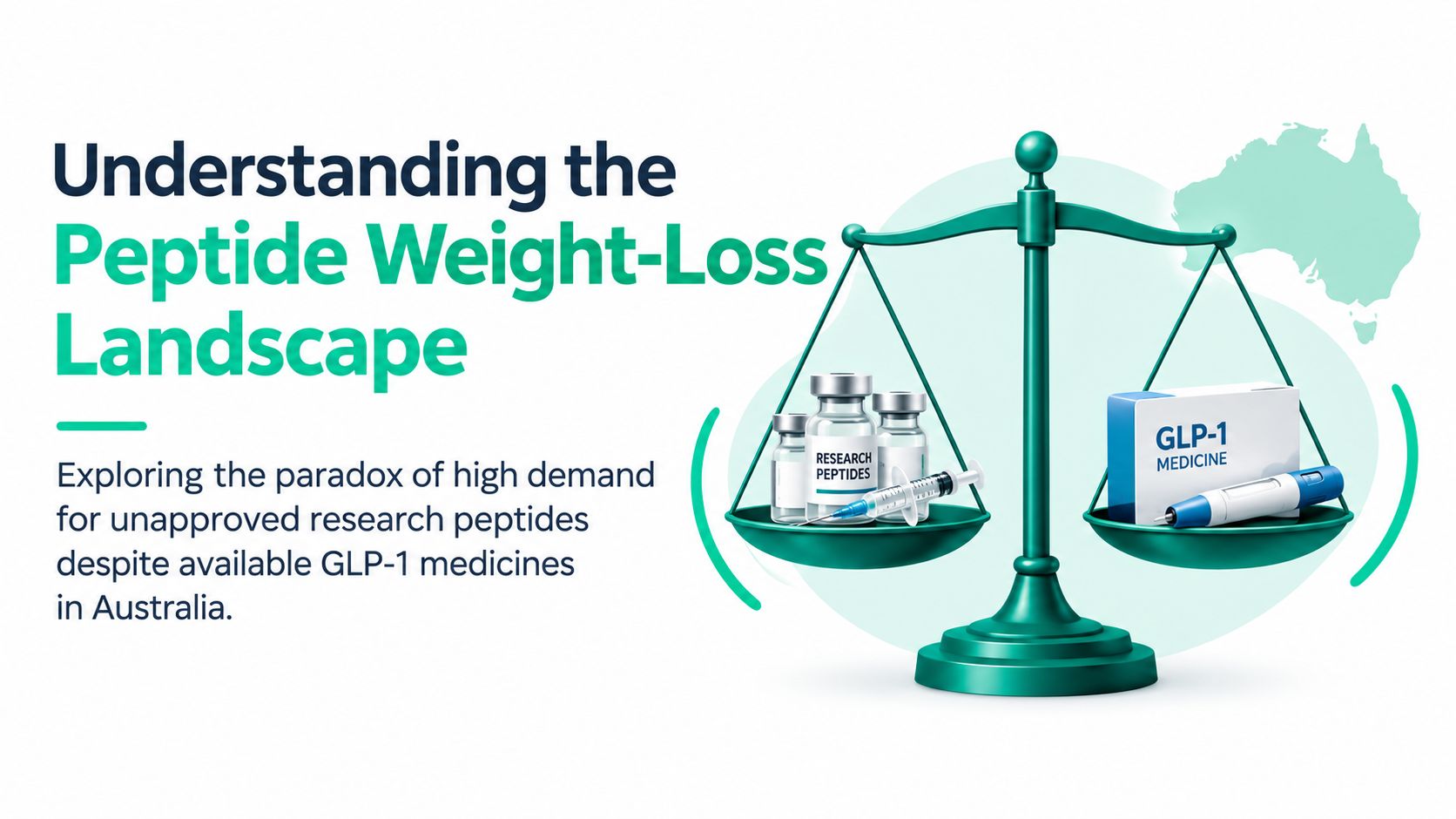
The apparent paradox is straightforward. Approved GLP-1 medicines are available in Australia, yet demand for online products labelled as “research peptides” remains high. The explanation isn't that the regulatory distinction has disappeared. It's that access, affordability, search behaviour and product verification are separate problems.
Semaglutide, liraglutide and tirzepatide are registered in Australia for relevant obesity or overweight indications, while the same words may appear on websites selling unapproved vials with no equivalent regulatory assessment. Australian Prescriber identifies injectable weight-management medicines including GLP-1 receptor agonists such as liraglutide and semaglutide, as well as the dual GIP/GLP-1 agonist tirzepatide. It defines chronic weight management in adults with obesity as BMI greater than or equal to 30 kg/m², or BMI 27 to less than 30 kg/m² with at least one weight-related comorbidity, as described in its clinical overview of injectable weight-management drugs.
Why demand persists beside approved medicines
PBS access doesn't mean universal subsidised access. The PBS consumer input summary on obesity treatments states that GLP-1 medicines aren't subsidised through the PBS for the purpose of losing weight, and that people seeking weight loss use must pay themselves. The same source notes that, at the time of its update, no medicine had yet been listed on the PBS specifically for weight management, despite three GLP-1 medicines being registered in Australia for overweight or obesity treatment.
That creates a procurement and consumer environment in which legitimate medicines can be available while remaining financially inaccessible to some people. Online sellers then capture search demand with language that may blur approved medicines, experimental compounds and laboratory materials. For institutions, the risk is that a familiar compound name is mistaken for evidence of lawful supply, validated identity or clinical suitability.
Practical rule: A compound name is not a provenance record. Treat the product identity, ARTG status, batch documentation and intended use as separate verification tasks.
The TGA has warned that many online peptide products are unapproved therapeutic goods and may be unlawful to import, supply or advertise. The regulator says these products haven't been assessed for safety, quality or effectiveness, and has issued warnings about counterfeit GLP-1 products and counterfeit retatrutide containing no GLP-1 at all. The TGA notice on unapproved peptide products is therefore directly relevant to laboratories evaluating an online source, not just to individual consumers.
For an Australian research organisation, the quick answer is this: don't treat an unapproved online “weight-loss peptide” as equivalent to an approved medicine or a documented research reagent. Establish the regulatory category first, then assess identity, purity, traceability and suitability for the proposed model.
Classes of Incretin Agonists in Research
Metabolic peptide research is easier to interpret when compounds are grouped by receptor activity rather than by marketing language. Three broad classes dominate current discussion: GLP-1 receptor agonists, dual GIP/GLP-1 agonists and tri-agonists.
A GLP-1 agonist such as semaglutide is designed to activate the GLP-1 receptor. Researchers study this pathway in relation to appetite-linked energy intake, glucose regulation and obesity management. Tirzepatide belongs to a different class because it engages both the GIP and GLP-1 receptors. The TGA's Australian public assessment report describes tirzepatide as a dual GIP/GLP-1 receptor agonist with synergistic effects on appetite, food intake and metabolic function. That receptor distinction is more informative than grouping both compounds under the broad label “peptide for weight loss”.
Tri-agonists extend the comparison by engaging three metabolic receptor pathways. Retatrutide is commonly discussed in this research context as a triple-agonist candidate. It shouldn't be collapsed into the same evidence category as registered medicines, however. A receptor design can justify laboratory investigation without establishing regulatory approval, clinical applicability or acceptable quality in an online vial.
| Peptide Agonist Classes | Receptor Targets | Primary Research Focus |
|---|---|---|
| GLP-1 agonists, including semaglutide | GLP-1 receptor | Appetite-linked energy intake, glucose regulation and obesity research |
| Dual agonists, including tirzepatide | GIP and GLP-1 receptors | Combined incretin signalling, appetite, food intake and metabolic function |
| Tri-agonists, including retatrutide in research contexts | Three metabolic receptor pathways | Comparative pathway activation and next-generation metabolic research |
The comparison shouldn't be interpreted as a ranking. Different receptor profiles produce different experimental questions, and results from one class can't automatically be transferred to another. A laboratory studying receptor signalling may prioritise pathway selectivity and identity confirmation, while a translational programme may also require documented formulation, stability and regulatory status.
Researchers evaluating semaglutide-specific mechanisms can consult the semaglutide research reference, but the product or source documentation still needs to be reviewed independently for the specific batch under consideration.
Mechanism isn't the same as evidence
The phrase “incretin agonist” describes pharmacology, not a complete evidence package. A human clinical trial, an animal model and an in-vitro receptor assay answer different questions. They also create different requirements for controls, dose normalisation, matrix selection and interpretation.
That distinction is particularly important for tri-agonists and other emerging compounds. A laboratory should report the model, exposure conditions and analytical confirmation rather than using clinical language to describe a preclinical result.
Clinical Evidence and Efficacy Data
Clinical evidence applies to a defined medicine, population, dose and treatment protocol. It cannot be transferred automatically to products sold online as research peptides, even when the label uses the same compound name. In Australia, that distinction also separates medicines assessed and approved by the TGA from unapproved products whose identity, formulation and manufacturing controls may not have been established to the same standard.
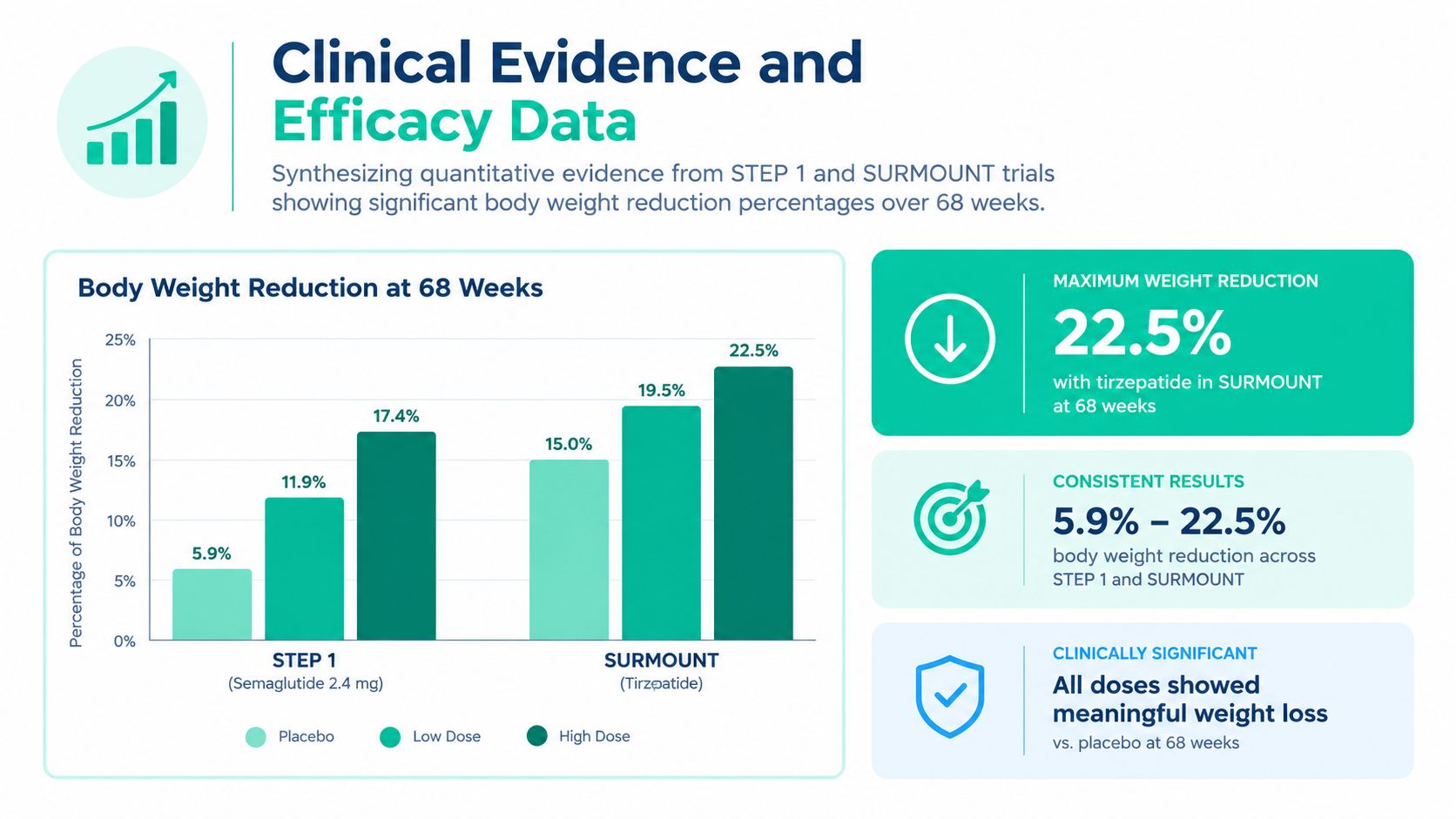
For semaglutide, Australian guidance reports mean weight loss of 14.7% to 17.4% at 68 weeks in adults without diabetes, with 15.2% maintained at two years, as summarised in the RACGP review of pharmacotherapy for overweight and obesity. These outcomes describe a clinical programme involving a specified medicine and monitored participants. They are not performance specifications for an unapproved vial.
The STEP 1 trial offers a more specific benchmark. The same review reports mean weight loss of 14.9% at 68 weeks with semaglutide 2.4 mg once weekly, compared with 2.4% with placebo. It also reports that 69.1% of treated participants lost more than 10% of body weight and 50.5% lost more than 15%. The results indicate efficacy under that trial design, not equivalence between a trial medicine and a research material.
What the numbers do and don't establish
The findings establish that semaglutide can produce substantial, measurable weight loss in a human obesity trial. They do not establish that every semaglutide-labelled research product has the same composition, stability, exposure profile or biological effect. A laboratory must therefore keep clinical endpoints separate from results generated in an assay, animal model or other preclinical system.
A Medical Journal of Australia review described substantial weight reduction with semaglutide at recommended obesity doses and identified the obesity-indication doses for liraglutide and semaglutide. Those observations belong to approved clinical use. They do not provide instructions for preparing, dosing or administering laboratory material.
Tirzepatide supplies a separate clinical benchmark rather than a direct substitute for semaglutide data. Australian regulatory documents describe a placebo-controlled obesity study that compared several weekly dose groups. That design supports assessment of dose-dependent efficacy within the studied programme. It does not show that an unapproved online product, different formulation or laboratory model will reproduce those outcomes.
The evidence supports four narrower conclusions:
- Human trials support the clinical activity of defined incretin medicines.
- Preclinical results should remain identified as preclinical.
- Product identity and clinical evidence are related, but not interchangeable.
- Australian procurement requires batch-level documentation alongside review of the product's regulatory status.
A focused semaglutide and tirzepatide research comparison may help frame the published differences between the compounds, but it should be read with the relevant TGA and trial documents.
The video provides supplementary context only. Researchers should still examine the original trial design, inclusion criteria, analytical methods and Australian regulatory documentation before drawing conclusions.
Laboratory Procurement and Quality Assurance
A defensible procurement workflow starts before a purchase order. The laboratory should define the research question, required material, intended model and minimum documentation package before comparing suppliers. That prevents a low price or familiar product label from becoming the main selection criterion.
A practical verification sequence
Define the material precisely. Record the compound name, salt or formulation if relevant, nominal quantity, intended assay and required delivery format. A broad request for “weight-loss peptides” isn't specific enough for a controlled study.
Request batch-level documentation. A Certificate of Analysis should identify the tested material, batch or lot, test date where available, reported methods and the entity that performed the testing. A specification sheet can describe an expected product profile, but it isn't automatically evidence that the current batch meets that profile.
Separate documentation sources. Manufacturer-provided documentation can support traceability, but it isn't equivalent to independent laboratory testing. Label each document as manufacturer-provided, independent, pending or unavailable in the procurement record.
Match the paperwork to the vial. Compare the batch number, product code, nominal quantity and label details against the purchase record. A COA for a different lot doesn't validate the material in front of you.
Review the analytical methods. HPLC can provide a reported chromatographic purity result, while mass spectrometry can support molecular identity. Neither method alone answers every question about aggregation, residual solvents, sterility, endotoxin status or stability. The required panel depends on the study and matrix.
Escalate uncertainty. If the documentation is incomplete, contradictory or unavailable, pause release to the study and ask the supplier for clarification or independent testing. An undocumented assumption is a poor substitute for a control.
Documentation rule: Record what the document proves, what it doesn't prove and who generated it. This is more useful than assigning a vague “high quality” label.
A laboratory manager can use a procurement information pack as one input to a broader supplier review, alongside institutional purchasing rules, ethics requirements and independent verification where the study warrants it.
Products are supplied strictly for laboratory research purposes only. They are not for human consumption, therapeutic use or diagnostic procedures.
The same principle applies to bulk formats. A larger order can improve study continuity, but it also increases the importance of lot segregation, receipt inspection, documented storage and a clear decision about whether every vial will undergo the same level of identity and purity review.
Storage, Reconstitution and Handling Protocols
Handling begins with the material's physical state and the study's validated stability plan. Lyophilised powder is generally managed differently from a prepared solution, and the appropriate conditions depend on the compound, container, excipients, reconstitution medium and duration of storage. The product documentation and the laboratory's own stability evidence should take precedence over generic online advice.
Concentration mathematics
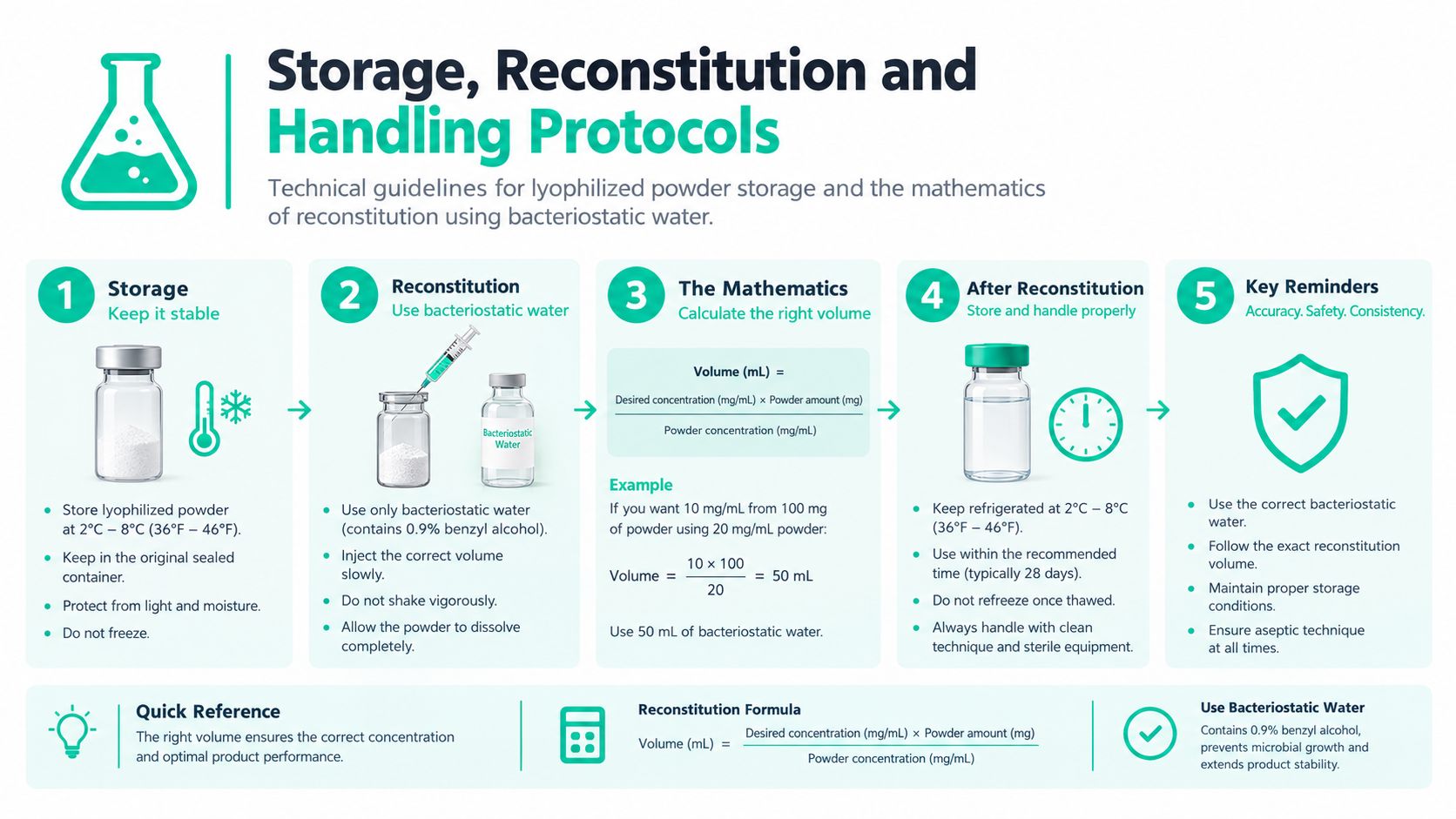
Reconstitution calculations are laboratory mathematics, not treatment instructions. If a vial contains a known mass of peptide and the laboratory adds a measured volume of diluent, the nominal concentration is:
Concentration in mg/mL = peptide mass in mg ÷ final solution volume in mL
For example, a vial containing a nominal mass M dissolved to a final volume V has a calculated concentration of M/V mg/mL. A planned aliquot volume can then be calculated from the required laboratory mass:
Aliquot volume in mL = required mass in mg ÷ concentration in mg/mL
These calculations only describe nominal concentration. They don't confirm recovery, homogeneity, degradation, adsorption to the container or actual biological activity. Record the vial mass, diluent identity, final volume, operator, date, calculation and any deviations in the experiment file.
Contamination and stability controls
Use an appropriate laboratory workspace, compatible sterile materials and a documented aseptic technique where the protocol requires it. Minimise repeated access to a prepared solution, label every aliquot clearly and separate research stocks from materials intended for analytical testing.
Storage decisions should account for:
- Temperature: Follow the compound-specific documentation and validated laboratory storage conditions.
- Light and moisture: Protect the material where the container or documentation indicates sensitivity.
- Freeze-thaw exposure: Avoid unnecessary cycles when the stability plan hasn't established their effect.
- Aliquoting: Use a documented aliquot plan to reduce repeated handling and preserve sample traceability.
- Quarantine: Hold received material until label, packaging, batch number and documentation have been checked.
“Bacteriostatic water” is a laboratory input, not proof that a preparation is sterile or suitable for every assay. The diluent, container and resulting solution must be compatible with the experiment, and the laboratory should document the basis for that decision. No preparation described here is intended for human administration.
Regulatory and Safety Considerations in Australia
Australian researchers need to distinguish three questions that online listings often combine: is the product registered, is the supply lawful, and is the material suitable for the proposed experiment? A “yes” to one doesn't answer the other two.
The TGA states that GLP-1 receptor agonists such as semaglutide and tirzepatide are synthetic analogues of native GLP-1. They are prescription-only medicines used for type 2 diabetes and, in some cases, weight management under medical supervision. The TGA safety alert on imported unregistered GLP-1 products also states that native GLP-1 isn't included in the Australian Register of Therapeutic Goods and can't lawfully be supplied in Australia.
That wording creates an important compliance boundary. A registered medicine is not the same thing as a vial marketed online as a research peptide, and a research-use-only material isn't a substitute for a prescription medicine. Institutions should verify the relevant ARTG status, intended use, import pathway, advertising claims and supplier documentation before placing an order.
A compliance checklist for institutions
- ARTG verification: Confirm whether the named therapeutic product is entered in the Australian Register of Therapeutic Goods where registration is being claimed.
- Prescription status: Treat approved GLP-1 medicines as prescription-only products and keep clinical procurement separate from laboratory reagent procurement.
- Intended use: Ensure purchase records and internal labels identify laboratory research use without therapeutic or diagnostic claims.
- Import and supply review: Obtain advice from the institution's regulatory, biosafety or procurement team where the product is unapproved or imported.
- Counterfeit screening: Treat unusual labelling, inconsistent batch records, implausible claims or missing documentation as reasons to quarantine material.
- Incident escalation: Preserve packaging and records if identity, quality or adverse laboratory findings are questioned.
The Wegovy public assessment report states that Wegovy is indicated, alongside a reduced-calorie diet and increased physical activity, for weight management in adolescents aged 12 years and above with initial obesity and body weight above 60 kg. It also distinguishes the 2.4 mg weekly weight-management formulation from the 1.0 mg weekly semaglutide diabetes dose, as set out in the TGA Wegovy assessment report. Those are approved-medicine details, not instructions for laboratory use.
The regulator's concern about counterfeit and unapproved products is therefore not peripheral to procurement. It affects sample identity, research reproducibility, institutional liability and the validity of downstream conclusions.
Conclusion and Research Resources
The evidence supports a careful conclusion. Incretin agonists have a substantial human clinical evidence base in defined medicines, while emerging compounds and online research products require a different standard of interpretation. Australian teams must separate receptor mechanism, clinical evidence, ARTG status, intended use and batch-level quality documentation.
For a defensible study, start with the protocol and work backwards to the material specification. Check identity and lot traceability, distinguish manufacturer documents from independent testing, record storage and preparation calculations, and refer regulatory questions to the appropriate institutional or TGA resources. A research library, compound glossary and COA record can support review, but none replaces the laboratory's own acceptance criteria.
Products are supplied strictly for laboratory research purposes only. They are not for human consumption, therapeutic use or diagnostic procedures.
Bulk Aussie Peptides provides research-use-only peptides, laboratory supplies, product specifications and batch documentation for Australian laboratory procurement workflows. Visit Bulk Aussie Peptides to review the research catalogue and documentation options for your study.