
Peptide Therapy in Australia: Approved or Unapproved?

Meta title: Peptide Therapy in Australia: Approved or Unapproved? Meta description: Peptide therapy in Australia covers four very different product categories. Here's how to check ARTG status, trial pathways and batch documentation.
A product marketed as peptide therapy arrives with a sealed vial, a polished website and a certificate attached. What has been confirmed about it?
The answer depends less on the molecule than on the category. Peptide therapy is an umbrella term for treatment using peptides, which are short chains of amino acids and smaller than proteins. Some peptides are approved medicines used under medical supervision, with insulin the familiar example and several GLP-1 receptor agonist medicines among the rest. The same phrase also covers trial products, unapproved goods sold online and laboratory material. Being a peptide says nothing about whether a product is approved, safe or suitable for anyone.
Table of Contents
- What Peptide Therapy Means and Where It Stops
- How Australian Law Classifies Peptide Products
- Red Flags in Online Peptide Claims
- What Published Research Can and Cannot Show
- Certificates of Analysis and Batch Documentation
- Questions Readers Ask About Peptide Medicines
- Confirm Regulatory Status Before You Buy or Study
What Peptide Therapy Means and Where It Stops
The definition itself is narrow. Your body makes thousands of peptides as signalling molecules, and marketing stretches the vocabulary well past the chemistry. A research peptide glossary helps when words like analogue, sequence or lyophilised appear unexplained.
Where the phrase stops helping is at product level. Peptide therapy describes a class of molecules, not a regulatory status. Under it sit four different things: an approved prescription medicine, a product inside an authorised trial, an unapproved therapeutic good sold through a website, and research-use-only material supplied for laboratory work.
Each has its own paperwork and its own lawful pathway, and none inherits another's evidence. The sections that follow work through the Australian rules, the claims worth questioning, what studies can and can't show, and how batch records are read. This is general information, not medical advice.
Ask three questions of any product: is it on the Australian Register of Therapeutic Goods, what is it approved for, and what documentation exists for this batch?
How Australian Law Classifies Peptide Products
The category decides what can lawfully happen to a product. The TGA's guidance on therapeutic peptide products sets the frame: a peptide regulated as a therapeutic good generally must be entered on the ARTG before it can be imported, manufactured, supplied, exported or advertised. Products outside the register are generally unapproved therapeutic goods, meaning the TGA hasn't assessed their quality, safety or effectiveness. Many approved peptide medicines are prescription-only and can't generally be advertised to the public.
Our peptides in Australia overview walks through the same structure. Here it is in short form.
| Category | Regulatory status | Lawful use in Australia | What to verify |
|---|---|---|---|
| Approved medicine | Entered on the ARTG after TGA assessment | Supplied for its approved indication under prescribing rules | ARTG entry and the approved indication |
| Clinical trial product | Unapproved, studied under a formal trial pathway | Only within an authorised trial with oversight | Who runs the trial and under which pathway |
| Unapproved therapeutic good | Not assessed by the TGA for quality, safety or effectiveness | May be unlawful to import, supply or advertise | Nothing can be assumed about identity, labelling or sterility |
| Research-use-only material | Not a therapeutic good and not approved for human use | Laboratory research only | Batch-specific documentation and independent testing |
An ARTG listing is a checkpoint, not a blanket approval. The approved indication on the entry matters as much as the entry, because that indication is the purpose the regulator assessed.
Red Flags in Online Peptide Claims
The loudest red flag isn't a strange ingredient. It's certainty.
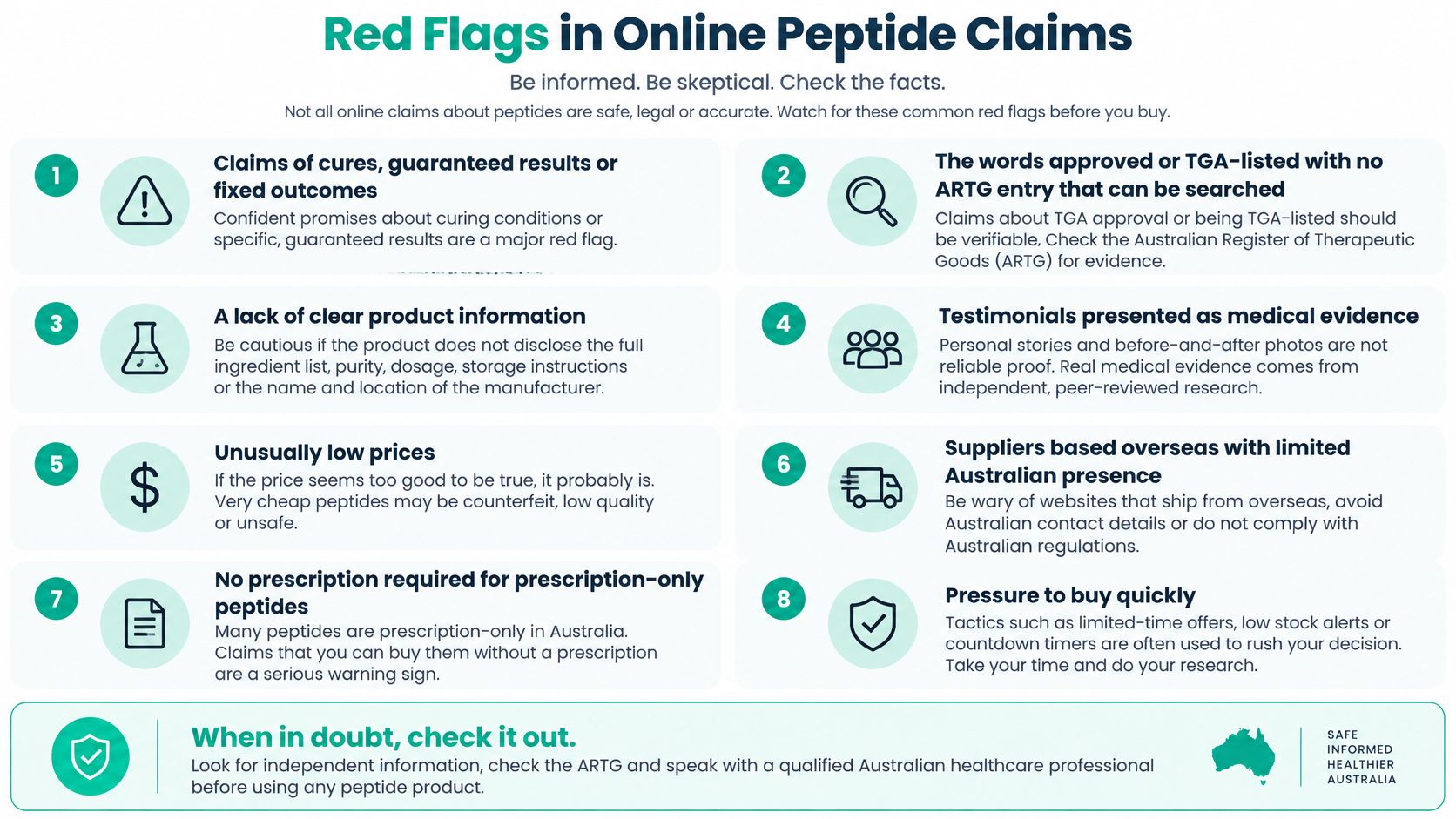
- Promises of cures or fixed results. A guaranteed outcome describes a sales pitch, not an assessment.
- The words approved or TGA-listed with no searchable ARTG entry. Unverifiable status is the claim, not the evidence.
- A research-use-only label on a product pitched for recovery, appearance or wellbeing. That label describes laboratory material and doesn't bridge the gap to approval.
- Wording that implies personal use or self-directed dosing. Approved medicines come with prescribing rules, not instructions in an advertisement.
- No batch identifier and no independent testing. Without both, identity, labelling and sterility can't be assumed.
- No named Australian supplier, no contact details, no GST invoice option.
- Testimonials standing in for evidence.
The signals that support a careful reading are duller: an ARTG number you can search yourself, an approved indication that matches the stated purpose, batch-specific certificates from an independent laboratory, and labelling that fits the product's category.
The TGA's peptide product information notes that many products promoted online are unapproved therapeutic goods and may be unlawful to import, supply or advertise. It also reports serious adverse effects linked to unapproved peptides, including liver damage and severe allergic reactions requiring hospitalisation.
If you'd rather watch than read, the explainer below covers the same verification steps.
What Published Research Can and Cannot Show
A positive paper belongs to one molecule, one formulation, one route, one population and one outcome. Move any of those and the finding weakens. Cell work shows a mechanism in a dish. Animal studies show a living system that is not human. Small human trials test tolerability and early signals. Large randomised trials test whether an outcome holds across a population.
Read the category before the conclusion. An approved GLP-1 medicine has trial evidence assessed by a regulator for a defined indication. A clinical trial product is still being tested, so protocol documents show intent and oversight, not proof of benefit. An unapproved product may have promising papers behind the molecule, but no regulator has accepted that preparation for supply. Research-use-only material can support laboratory questions, while its paperwork stays inside the lab.
Australia keeps that distinction formal: the TGA's clinical trials guidance describes two pathways for trials of unapproved goods, CTN and CTA. Being studied here is not approval for supply. A supplier's testing and documentation resources can describe handling and records, though records cannot upgrade a product's regulatory category.
Four questions for any study: which molecule, which study type, which outcome, and who regulated it?
Certificates of Analysis and Batch Documentation
A certificate of analysis (CoA) is a batch document: it reports tests run on one specific lot of material. In the four-way split this article uses, it belongs to research-use-only supply. It can support identity and purity for that batch, but it cannot show approval as a medicine, enrolment in a clinical trial, or that an unapproved product is safe to use.
What the tests actually show
Identity testing confirms the material is what the label says. Purity testing measures how much of the sample is the target compound and what else is present. The two standard methods are high-performance liquid chromatography (HPLC), which separates a sample into its components so they can be measured, and mass spectrometry, which confirms molecular mass. Batch level matters because a certificate covers one batch: the identifier on the report has to match the identifier on the vial you receive, or the document proves nothing about your material.
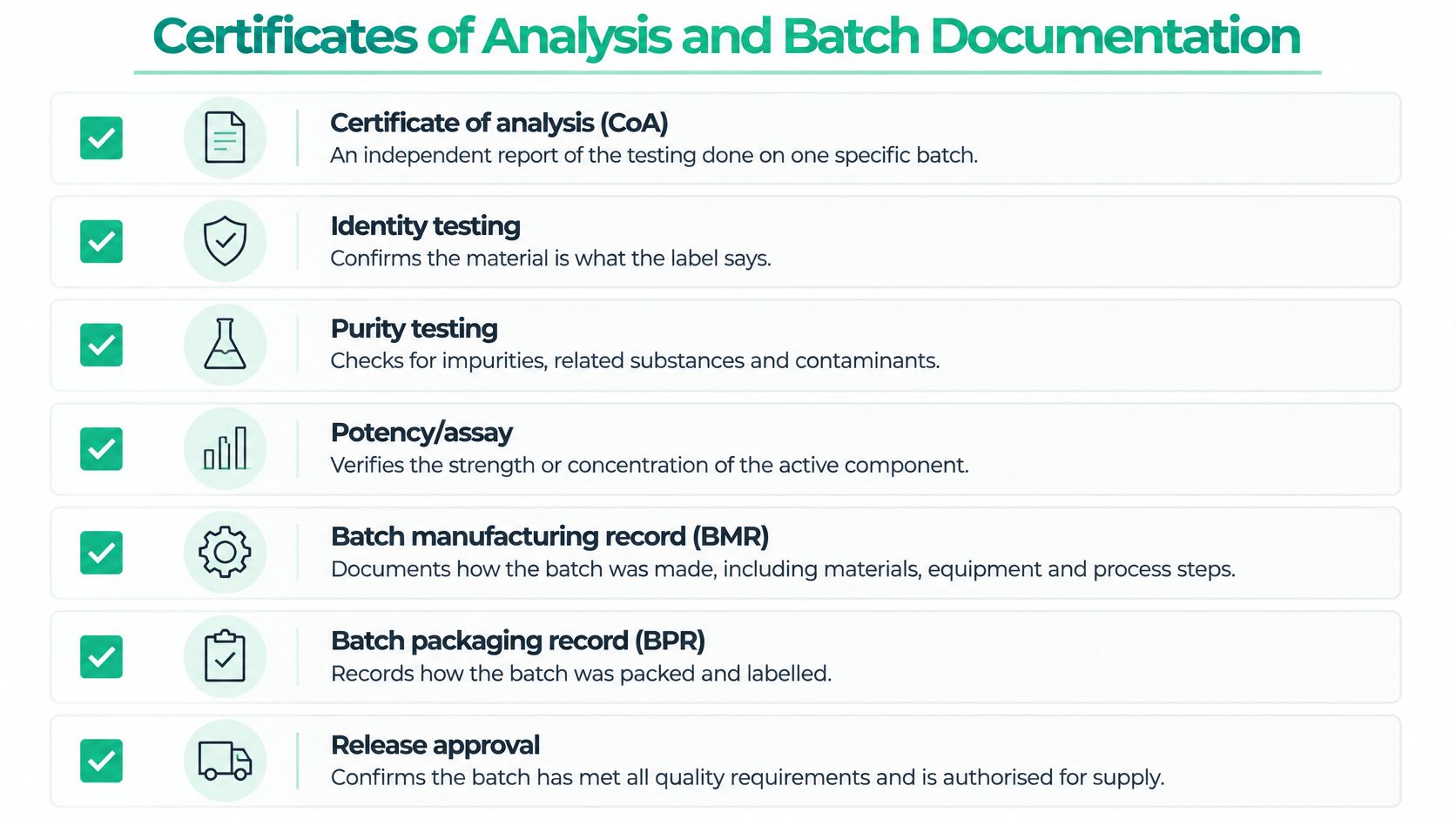
At Bulk Aussie Peptides, product pages carry specifications before ordering, and batch Certificates of Analysis plus third-party laboratory reports are available or on request for active customers; the COA library is the first place to check which documents exist for a product and whether each is labelled manufacturer-provided or independent laboratory.
A certificate proves testing, not approval. Those are two separate questions answered by two separate bodies of evidence.
Run this checklist against any certificate:
- Product name matching the label.
- Batch identifier matching your vial.
- Named laboratory and a clearly labelled documentation source.
- Methods listed, including HPLC and mass spectrometry.
- Strength and form consistent with the material supplied.
Questions Readers Ask About Peptide Medicines
Are peptide medicines available on prescription in Australia
Yes, for some products. Insulin and GLP-1 receptor agonist medicines are approved prescription medicines here, and the RACGP's summary of PBS data reports 2,397,521 PBS-subsidised semaglutide prescriptions in 2023–24, at a cost of AUD 284.6 million to the Australian Government. Approved medicines are used under medical supervision, so a question about your own health belongs with a registered health professional.
Where can a concern about an advertised peptide be reported
To the Therapeutic Goods Administration, which handles complaints about advertising and supply. Until that's resolved, don't treat the advertisement as evidence of safety or approval.
Can a supplier's website confirm regulatory status
Not on its own. A website statement doesn't replace a register entry, so search the ARTG directly and compare what you find with the marketing. Our FAQ page answers the documentation questions that come up most often.
Confirm Regulatory Status Before You Buy or Study
Online peptide content often merges four separate categories: approved medicines, clinical trial products, unapproved products and research-use-only material. Each has different paperwork, and each document proves a narrower point than marketing implies.
- Confirm the category. Search the ARTG and read the TGA guidance for that product type before anything else. An ARTG entry supports approved-medicine status; a trial record supports a study context; a label or product page does not prove either one.
- Read the label as a category statement. Material supplied for laboratory research is for research use only. A research label explains intended use; it does not create approval for human use.
- Pull the batch record. Request documentation and match the batch identifier to the certificate linked from the product page. A Certificate of Analysis can support identity and purity for that batch; it cannot prove legal status, clinical safety or effectiveness in people.
- Plan the purchase properly. For institutional or bulk work, ask for the Procurement Pack or a quote, and the Australian-based support team can help with specifications and selection.
Bulk Aussie Peptides is Australian owned and operated, with order processing and dispatch within 1–3 business days, shipment tracking and stated delivery windows. Everything above is general information about how products are classified and documented, and none of it is medical advice.
Bulk Aussie Peptides supplies research-use-only peptides in 10-pack formats with transparent AUD pricing, across a catalogue of more than 60 compounds. Batch Certificates of Analysis and third-party laboratory reports are available through the lab library or on request for active customers. If you're sourcing material for laboratory work, you can compare specifications, request documentation, or ask for the Procurement Pack before you commit to an order. Visit Bulk Aussie Peptides to start with the lab library and the bulk research supply options.
- BAP