
Peptides and Their Research Uses: An Australian Guide

Meta title: Peptides and Their Research Uses in Australia
Meta description: Understand peptides and research categories, batch certificates, Australian regulation and practical supplier checks.
Does a laboratory certificate mean a peptide is approved? No. Understanding peptides and their research uses starts with separating three questions: what the compound is, what a particular batch contains, and how Australian regulators classify the product. A certificate can help answer the second question, but it doesn't settle the third.
Table of Contents
- What Peptides Are and Why the Sequence Matters
- Peptides and the Research Areas They Cover
- Research Use Labels and Australian Regulatory Status
- How a Certificate of Analysis Verifies a Batch
- Supplier Checks Before You Order
- Common Questions About Peptide Research
What Peptides Are and Why the Sequence Matters
A peptide is a short chain of amino acids joined by peptide bonds. Think of different coloured beads on a string: each bead represents an amino acid, and their order defines the compound.
Swap a bead and you've changed the peptide. That's why a familiar name on a vial isn't enough to establish identity.
Peptides are generally shorter than proteins. Proteins have longer amino-acid chains that fold into particular shapes, although the boundary between the terms isn't always sharp.
Key distinction: A similar-looking powder doesn't establish that two vials contain the same molecule.
The body makes many peptides naturally; researchers also work with synthetic peptides made in laboratories. For unfamiliar terms such as sequence and synthesis, our research peptide glossary provides a plain-English reference.
For laboratory work, three details belong together: the named sequence, the supplied form and the supporting batch documentation.
Peptides and the Research Areas They Cover
| Research area | What research has examined |
|---|---|
| Metabolic | Glucose metabolism, appetite signalling and GLP-1 receptor pharmacology |
| Growth-factor and growth hormone secretagogues | Growth-signalling pathways in laboratory research |
| Tissue and cellular | Tissue remodelling and cell-level research |
| Longevity and senescence | Cellular ageing and senescence pathways |
| Neuroscience | Nervous system and brain research |
| Skin, hair and nail | Skin and cellular research |
Metabolic research concerns how the body handles glucose and appetite signals. GLP-1 is a signalling hormone, while receptor pharmacology examines how compounds interact with its receptor.
Growth-factor research examines signals involved in cell and tissue growth. Tissue and cellular research focuses on tissue structure and cell behaviour.
A research category describes a field of investigation, not a demonstrated benefit.
Longevity research includes senescence, a state in which cells stop dividing. Neuroscience concerns the nervous system and brain; skin-related research examines skin cells and associated structures.
Our research compound database helps readers understand these categories. A listing identifies a research material, not proof of an outcome, and research-stage compounds aren't interchangeable with approved medicines.
Research Use Labels and Australian Regulatory Status
A research-use-only label doesn't, by itself, settle whether supply is lawful. The TGA's peptide products guidance explains that composition, presentation, claims and intended use all affect classification.
Claims about weight management, muscle growth or recovery can bring a product within therapeutic-goods regulation. Therapeutic goods generally require entry in the Australian Register of Therapeutic Goods (ARTG), or a specific exemption, approval or authority, before importation or supply.
Research peptide regulation checks
Read the website, packaging and accompanying documents together. Confirm the stated research purpose and whether the proposed study needs institutional ethics or biosafety review.
A certificate of analysis records testing of a batch. It isn't an ARTG entry or evidence of TGA assessment.
Our Australian research peptide regulation guide provides further context. Keep records of the product description and stated research purpose rather than relying on a label alone.
How a Certificate of Analysis Verifies a Batch
A certificate of analysis (CoA) is a laboratory report for a specific batch, not blanket evidence for a product line.
Identity checks commonly include mass spectrometry, which measures molecular mass. A matching mass supports identity but doesn't alone establish the complete sequence. HPLC, or high-performance liquid chromatography, separates components to assess purity; its reported percentage isn't necessarily the proportion of the entire powder that is peptide.
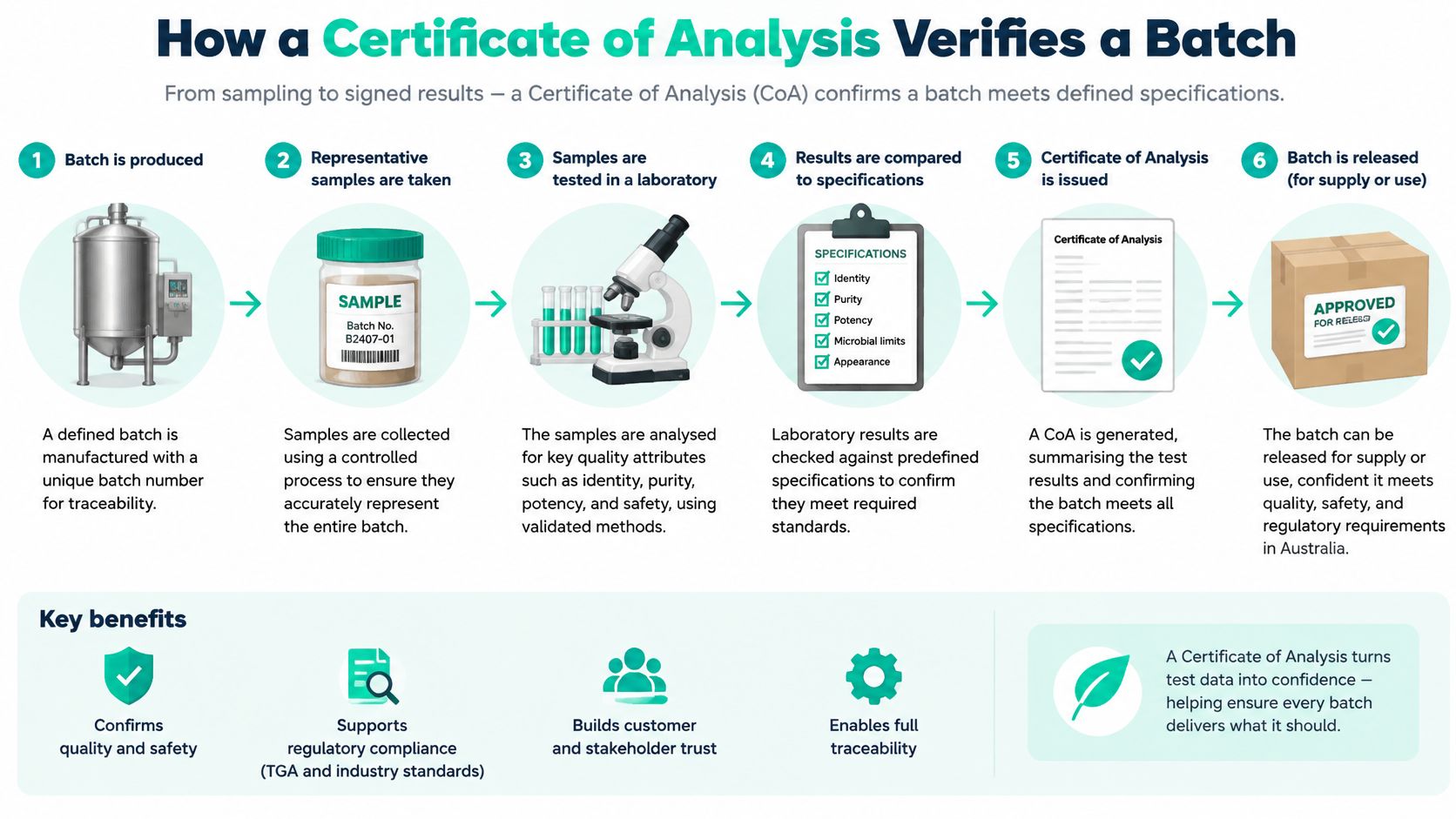
Net peptide content describes the amount of peptide present. The TGA's practitioner guidance supports reviewing identity, content, purity and relevant microbiological evidence together, because degradation and contamination are separate concerns.
Batch documentation checks
- Match the records. Reconcile the CoA with the batch and physical vial label.
- Check identity. Identify the analytical method and reported finding.
- Review purity. Read the method, result and net peptide content.
- Identify the laboratory. Confirm who performed the work and its scope.
- Review provenance. Check transport records and the documented storage history.
The TGA's product-testing warning found that tested unapproved peptides didn't always contain what their labels claimed.
Our independent CoAs sit in the online lab library and are linked on each product page. Pending pages state in testing.
Supplier Checks Before You Order
A supplier's paperwork shows what you can verify before money changes hands. Use these criteria to separate documented claims from marketing claims.
| Criterion | What to look for | Why it matters |
|---|---|---|
| Batch testing | Batch CoA linked from the product page | Connects records to stock |
| Pending testing | Explicit in testing notice | Identifies outstanding results |
| Pack format | Standardised 10-packs priced in AUD | Makes quantity comparisons clearer |
| Documentation | Request documentation service and procurement pack available | Supports institutional purchasing reviews |
| Dispatch | Dispatch typically within 1–3 business days; tracked shipping, free over $500 AUD | Provides a planning estimate |
| Testing laboratory scope | Relevant ISO/IEC 17025 accreditation through NATA | Supports assessment of testing competence |
Two checks deserve particular attention: laboratory scope and document-to-stock matching. The TGA Laboratories guidance identifies NATA accreditation to ISO/IEC 17025 as the relevant pathway for Australian non-medical testing laboratories.
Scope is the catch. A laboratory can hold accreditation for one method while running a different test outside it, so the report you read should name a method that falls inside the accredited scope. A badge on a website proves nothing on its own.
Matching matters just as much. A CoA works like a receipt: it says something about one batch, and nothing about the next lot. A valid report for different stock leaves the batch being offered unverified. And no certificate, however thorough, amounts to TGA approval or an ARTG listing, so a batch check ends at verification and stops short of any approval claim.
Buying rule: Compare price after you've established what the documentation actually covers.
Our Australian supplier evaluation guide supports that comparison, and our Australian-based support team assists with research specifications and documentation requests.
Before ordering, confirm the product-page report is available, reconcile its identifiers with the supplied stock and review the testing scope. If a batch document can't be shown, treat that batch as unverified.
Common Questions About Peptide Research
Are research peptides approved medicines?
Not because they're peptides or have laboratory reports. The TGA's therapeutic peptide regulation guidance states that unapproved products haven't been assessed for safety, quality or effectiveness.
What does in testing mean on a product page?
It means results aren't yet posted in the lab library. Don't treat a pending result as completed documentation.
What form are research peptides supplied in?
Our research peptides are supplied as freeze-dried powder cake in sealed glass vials for laboratory research. Appearance alone can't establish the contents.
Bulk Aussie Peptides is Australian owned and operated, offering research peptides in standardised 10-pack formats with AUD pricing and GST invoices available. Visit Bulk Aussie Peptides to review research specifications and linked batch documentation before making a procurement decision.
- BAP