
Retatrutide Australia: Research, Access, and Sourcing Guide

A single Australian regulatory alert changed the practical conversation around Retatrutide Australia. On 14 September 2026, the Therapeutic Goods Administration stated that retatrutide is still undergoing human clinical trials, has not been approved by the TGA or any comparable international regulator, and that any retatrutide product accessed outside a clinical trial could be counterfeit and shouldn't be used outside a trial setting, according to the TGA safety alert on counterfeit retatrutide.
For Australian laboratories, universities, CROs and procurement teams, that pushes retatrutide into a very specific category. It is an investigational compound with active research relevance, not a routine therapeutic stock item. The operational question isn't “what is retatrutide?” It's “what evidence, documentation and controls must sit behind any vial before it enters an Australian research environment?”
That distinction matters because public discussion often blurs three separate issues:
- Mechanism and published science. Retatrutide has been studied as a triple agonist in peer-reviewed research.
- Clinical development status. It remains under investigation rather than approved for general medical use.
- Australian access and verification. Labs need batch traceability, chain-of-custody clarity and research-use-only controls.
Practical rule: If a compound is visible in trial systems but absent from normal therapeutic approval pathways, procurement should treat it as a documentation-first purchase, not a catalogue convenience item.
Products are supplied strictly for laboratory research purposes only. They are not for human consumption, therapeutic use or diagnostic procedures.
Table of Contents
- What Australian Researchers Need to Know About Retatrutide in 2026
- How Retatrutide Works as a Triple Agonist
- What the Peer-Reviewed Evidence Actually Shows
- TGA Status, Counterfeit Alerts, and Australian Trial Activity
- Documentation Australian Labs Should Expect With a Research Vial
- Reconstitution, Storage, and Handling for Laboratory Use
- Verifying Batch Provenance and Documentation Before You Order
- Procurement Checklist and Research Catalogue Next Steps
What Australian Researchers Need to Know About Retatrutide in 2026
A single regulator warning can change an entire purchasing pathway. In Australia, retatrutide sits in that category.
For Australian researchers in 2026, the first practical question is not whether the molecule is scientifically interesting. It is whether the material can enter the building with the right controls, records, and internal approvals attached. The current Australian position is clear. Retatrutide remains an investigational compound, and the TGA alert on retatrutide and counterfeit product risk warns that products obtained outside legitimate channels may be counterfeit.
That changes the procurement file immediately. A vial of retatrutide should be treated less like routine laboratory stock and more like a restricted reference material. Before receiving signs off, the file should show what the compound is, why it is being ordered, how it will be used in a research setting, and which documents support identity, traceability, storage, and internal authorisation.
This is the point Australian labs often need clarified. Trial activity, conference discussion, and online listings do not create approval status. They also do not reduce the burden on procurement. If anything, they increase it, because the gap between scientific interest and ordinary legal supply is where documentation failures tend to appear.
The four questions procurement usually asks first
A useful way to organise the issue is to separate it into four checks.
- What is its status in Australia? Retatrutide is under investigation, not approved as a routine therapeutic product in Australia.
- What kind of evidence supports interest in it? The published literature supports ongoing research interest, but that is different from market approval or normal clinical access.
- What should accompany a research vial? Procurement should expect a traceable batch identifier, analytical documentation, clear labelling, and records that support chain of custody.
- When should verification happen? Before payment and before dispatch approval, not after goods receipt.
For teams writing or updating SOPs, a broader review of research peptide regulation in Australia helps align procurement, lab operations, and governance staff around the same definitions.
The confusion around retatrutide usually comes from category drift. One document discusses clinical investigation. Another refers to peptide supply for research. A third mentions Australian regulation in general terms. If those categories are blended, staff can mistake scientific visibility for purchasing clearance.
A better working rule is simple. In Australia, retatrutide belongs in documented research workflows, with ethics, biosafety, receiving, and inventory controls checked before the vial arrives.
How Retatrutide Works as a Triple Agonist
Retatrutide is being studied because it binds to three metabolic receptor systems in one molecule: GIP, GLP-1 and glucagon. That combination is the central design feature described in the PubMed-indexed review of retatrutide pharmacology and development. For an Australian procurement file, that matters because the mechanism explains why the compound appears in research discussions, while still remaining separate from any claim of approved therapeutic availability.
A practical comparison helps. A single-agonist peptide acts on one signalling channel. A dual agonist covers two. Retatrutide was built to engage three channels at once, with the aim of influencing overlapping parts of metabolic regulation rather than one receptor pathway in isolation.
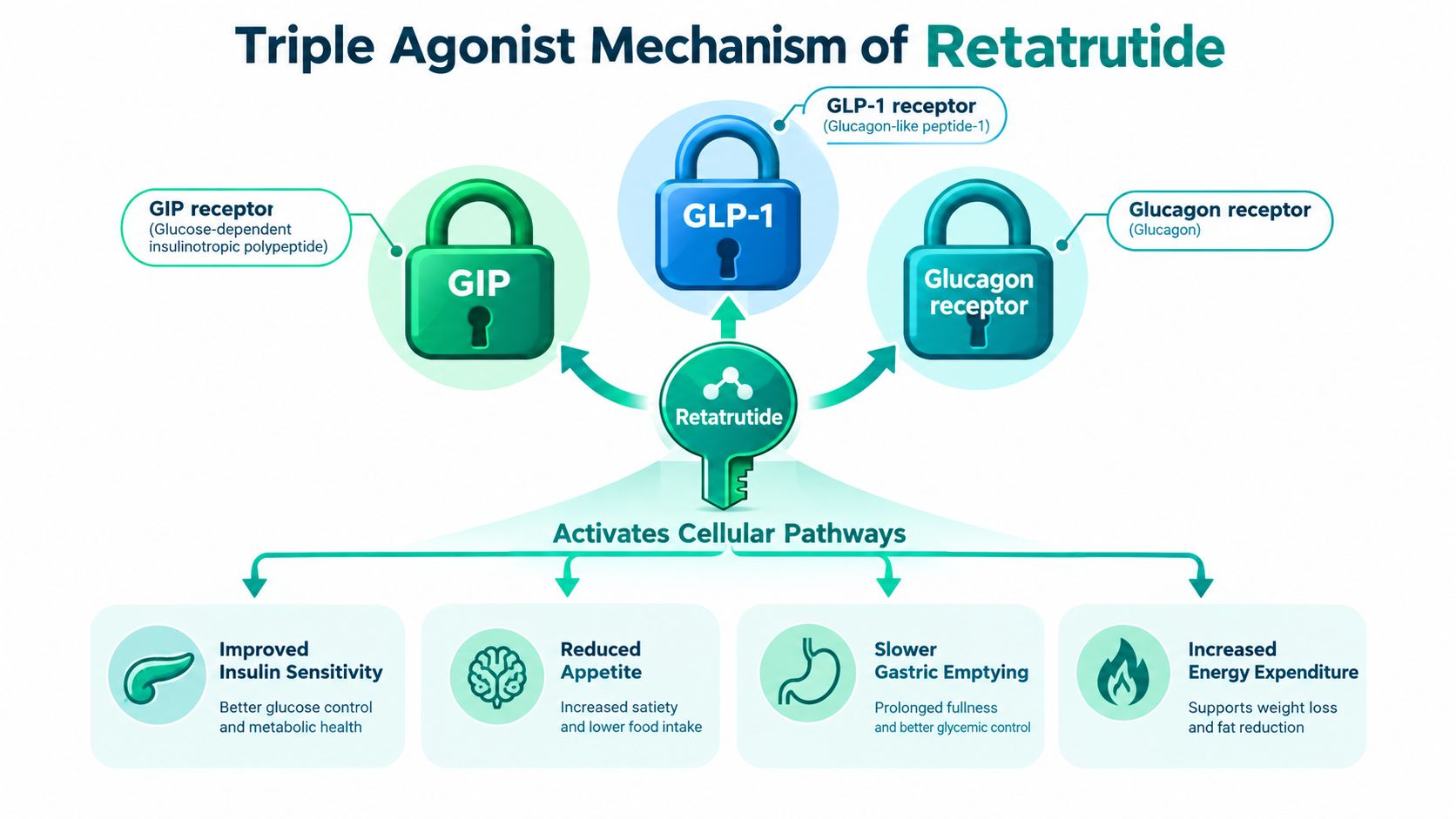
The easiest way to read the mechanism is as a division of labour across three receptor families.
GIP receptor activity is studied for its role in nutrient-responsive endocrine signalling. In plain terms, it sits within the body's meal-related signalling system.
GLP-1 receptor activity is investigated in connection with appetite signalling and slower gastric emptying. This is the receptor class many readers already recognise from other incretin-based research, which is why retatrutide can be misunderstood as just another GLP-1 agent. It is broader than that.
Glucagon receptor activity adds the part that often causes confusion. Researchers examine this pathway in relation to hepatic metabolism and energy expenditure. That makes retatrutide mechanistically different from peptides that stay within incretin signalling alone.
One way to frame it is as a three-input control system. GIP and GLP-1 relate to familiar incretin biology. Glucagon receptor engagement adds a second metabolic layer, particularly around liver and energy-handling pathways. The scientific interest comes from that combined architecture.
For research teams, the key point is precision of language. It is reasonable to describe retatrutide as an investigational triple agonist with studied activity at those three receptors. It is not careful to convert receptor binding and signalling rationale into broad claims about established clinical use in Australia.
That distinction belongs in the procurement record as much as in the lab notebook.
In purchasing and inventory documents, describe retatrutide by its studied receptor profile and investigational status. Do not describe it as an approved therapeutic product available for routine clinical use in Australia.
What the Peer-Reviewed Evidence Actually Shows
Three different evidence layers sit under the retatrutide literature, and each answers a different procurement question. One asks whether the molecule activates the intended receptors. Another asks what happened in animal models. The third asks what has been studied in human participants under trial conditions.
That separation matters in an Australian research file because a receptor paper, an animal paper, and a phase 2 clinical paper do not support the same claims.
Read the evidence as a ladder, not a single block
At the in vitro level, researchers test whether retatrutide activates GIP, GLP-1, and glucagon receptors in assay systems. This is the bench equivalent of confirming that three keys fit three locks. It supports the proposed mechanism. It does not answer whether a product offered for sale in Australia is genuine, approved, or suitable for any clinical use.
At the preclinical level, animal studies have examined changes related to food intake, body weight, adiposity, and liver-associated measures. Those papers help researchers decide which questions are mature enough for human investigation. They are useful for study design and scientific context, but they do not replace human safety and efficacy data.
At the human clinical level, the published record is more relevant to ethics committees and procurement officers because it shows that retatrutide has been studied in formal development programs, including phase 2 settings. Even here, the wording must stay tight. Human investigation shows studied outcomes under trial protocols. It does not establish TGA approval, routine clinical availability in Australia, or permission to treat patients outside authorised pathways.
Retatrutide evidence by study type
| Evidence type | Model or cohort | Primary readouts | What it supports, and what it does not |
|---|---|---|---|
| In vitro | Receptor and signalling systems | Agonist activity at GIP, GLP-1, and glucagon receptors | Supports mechanistic plausibility. Does not establish clinical effectiveness, product authenticity, or regulatory status |
| Preclinical animal research | Rodent metabolic models | Food intake, adiposity-related measures, liver-related markers | Supports hypothesis generation and translational rationale. Human relevance remains limited until confirmed in clinical studies |
| Human clinical investigation | Phase 2 obesity and type 2 diabetes development context | Safety, tolerability, and investigational metabolic outcomes | Supports discussion of studied trial outcomes. Does not equal TGA approval, routine prescribing, or open commercial availability in Australia |
What belongs in the procurement file
For Australian labs, the practical question is usually not "is there any literature?" It is "what exactly does the literature allow us to say on a purchase request, ethics application, or receiving record?"
Use the primary paper, state the study type, and match the claim to the evidence. If a paper reports receptor agonism, record receptor agonism. If a paper reports investigational human outcomes under trial conditions, record that narrower point. Do not stretch either category into claims about lawful consumer purchase, therapeutic use, or expected performance of a vial supplied outside a recognised trial framework.
A good file reads like chain-of-custody for claims. Each statement should trace back to a specific paper and stay within that paper's limits. That is the standard that helps a vial enter the building with the right scientific context, rather than with assumptions copied from search results for Retatrutide Australia.
TGA Status, Counterfeit Alerts, and Australian Trial Activity
Australian procurement files usually rise or fall on three checks. What the TGA has approved, what the regulator has warned about, and whether Australian trial activity exists in a documented research setting.
For retatrutide, those checks point in the same direction. It remains an investigational compound rather than a TGA-approved therapeutic product in Australia. Public regulatory warnings have also made a second point clear. Material sold outside controlled channels may be mislabelled or counterfeit.
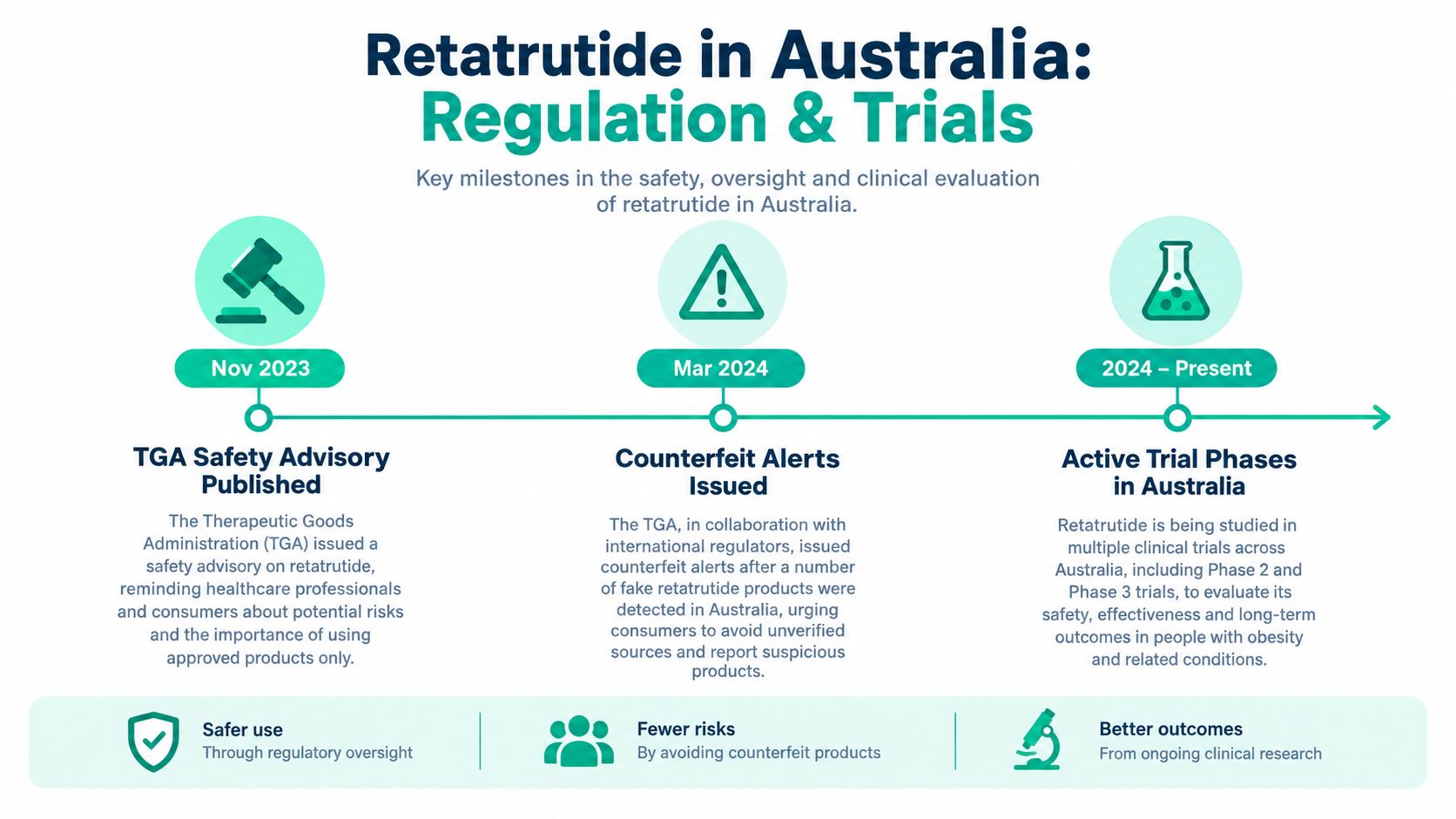
What the counterfeit issue means operationally
A counterfeit alert matters to a lab in the same way a failed chain-of-identity check matters to a reference standard. The problem is not only legal or clinical. It is analytical. If the label and the contents do not match, every downstream record becomes unreliable.
Australian readers should therefore separate two questions that are often blurred together online. One question is whether retatrutide is being studied. The other is whether a vial offered for sale can be trusted to contain what the label claims. The TGA warning discussed earlier shows why those are different questions.
Public reporting on the warning stated that one tested product sold as retatrutide did not contain retatrutide and instead contained undeclared semaglutide, alongside a serious adverse event report, as described in The Guardian's report on the TGA counterfeit warning and Australian harms.
That is the practical lesson for receiving teams. A product name on a vial is only a claim. Identity has to be supported by paperwork, and in higher-risk cases by independent analytical confirmation.
A short overview of the public-facing issue appears here:
Where Australian trial activity fits
Trial visibility does exist, but it should be read carefully. A registry entry shows that retatrutide appears within Australian trial records, including the SYNERGY-OUTCOMES study context for metabolic and liver-related outcomes, as reflected in Australian trial registry search visibility for retatrutide.
That does not convert a trial-stage molecule into a generally available Australian product. A registry record answers a narrow question. It shows that formal study activity is visible. It does not certify any vial offered through informal supply channels, and it does not replace TGA approval.
For a procurement officer or lab manager, the file should therefore read like a controlled-entry decision. Is the material tied to a legitimate research framework, with ethics and site controls where relevant, or is it entering on the strength of a label and a sales page alone? That is where retatrutide currently sits in Australia. Between active scientific interest, clear regulatory caution, and a high burden of documentation before any vial should cross the receiving bench.
Documentation Australian Labs Should Expect With a Research Vial
A procurement file for retatrutide should let an auditor answer a simple question without guessing. What arrived, which batch was it, how was it described by the supplier, and what evidence links that vial to analytical testing?
For Australian labs, the paperwork matters as much as the label on the tube. Retatrutide sits in a trial-stage and high-scrutiny category, so receiving a vial without a matched document set creates immediate problems for biosafety review, reproducibility, and institutional sign-off.
Minimum documentation set
The useful benchmark is a batch-linked file, not a generic product page saved as a PDF. Procurement officers and lab managers should be able to trace the material from quote to delivery to bench release.
Standard Research-Use-Only Documentation Pack
| Document | Purpose | What to Check |
|---|---|---|
| Product label and SKU record | Identifies the exact material ordered | Product name, format, lot or batch number, research-use-only wording |
| Certificate of Analysis | Links the batch to analytical testing | Date, batch match, analytical methods, identity and purity fields |
| Specification sheet | Describes the supplied presentation | Match to the ordered format, including 10 mg × 10 where applicable |
| Safety data or handling sheet | Supports local risk assessment and storage review | Handling notes, storage conditions, hazard presentation |
| Packing slip or shipping manifest | Preserves shipment traceability | Lot reconciliation across shipment, carton, and vial |
| Supplier declaration of research status | Records intended use boundaries | Explicit statement that the product is for laboratory research only |
What matters most on the COA
The COA usually carries the greatest evidentiary weight. It is the document that should connect the physical vial in the receiving area to a specific tested batch.
Labs should check four points first. Identity confirmation, usually by mass spectrometry or an equivalent method. Purity reporting, often supported by chromatographic data such as RP-HPLC. Exact lot matching across the COA, vial label, and outer packaging. An issue date and named methods, so the certificate reads like a test record rather than a summary claim.
A good way to read the COA is to treat it like an instrument log attached to a sample. If the batch number is missing, the method is unnamed, or the purity statement has no analytical context, the document does not do its job.
The content owner's procurement guidance reflects the same expectations commonly used in Australian research settings. Batch-specific COAs, RP-HPLC purity reporting, ESI-MS identity confirmation, and lot-matched records that can stand up to internal review.
Missing batch numbers, vague purity claims, and unlabeled vials create a documentation gap that may fail ethics, biosafety, or reproducibility review.
Red flags that justify a hold
Some receiving issues should stop bench release until the supplier answers them in writing.
- Undated certificates
- A batch number on the vial that does not match the COA
- No analytical method named on the certificate
- No clear research-use-only statement
- Packaging that names the peptide but provides no lot traceability
That hold point is practical, not bureaucratic. Once a vial is booked in, aliquoted, or shared internally, it becomes much harder to reconstruct provenance later.
Products are supplied strictly for laboratory research purposes only. They are not for human consumption, therapeutic use or diagnostic procedures.
Reconstitution, Storage, and Handling for Laboratory Use
A vial becomes a usable laboratory stock only after two things are set clearly on paper: the target concentration and the storage plan. Without those, reconstitution is just adding liquid and hoping the maths stays consistent across operators.
For a 10 mg lyophilised retatrutide vial, the concentration depends entirely on the volume added. Add 2.0 mL and the stock is 5.0 mg/mL. Add 2.5 mL and the stock is 4.0 mg/mL. That sounds simple because it is simple. The risk appears later, when one team records mg per vial and another records mg/mL, then both assume they are discussing the same stock.
A useful way to frame reconstitution is to treat it like setting the scale on a balance before weighing a reference standard. The peptide amount in the vial is fixed. The diluent volume sets the working concentration your assays will inherit.
Here is the same calculation in a bench-ready format:
| Vial Content | Diluent Added | Final Concentration | Why a Lab Might Choose It |
|---|---|---|---|
| 10 mg | 2.0 mL | 5.0 mg/mL | Higher stock concentration, useful if later dilutions are planned |
| 10 mg | 2.5 mL | 4.0 mg/mL | Slightly lower stock concentration, often easier for routine pipetting |
Technique matters because rough handling can create avoidable variability during dissolution. A calm, repeatable method is usually enough:
- Add diluent down the inside wall of the vial rather than directly onto the cake with force.
- Let the liquid wet the lyophilised material fully before mixing further.
- Swirl gently until dissolved.
- Avoid vigorous shaking or vortexing unless your internal method specifically permits it.
- Aliquot soon after preparation if the stock will be used across multiple assay runs.
- Mark each aliquot with concentration, batch or lot, preparation date, and operator initials.
Labs that want a calculation reference before writing a worksheet can use this research peptide reconstitution guide.
Storage should also be written as a study control, not left as a verbal habit. The handling notes associated with this product format indicate 2°C to 8°C for reconstituted material intended for near-term use, and -20°C for unopened lyophilised vials kept for longer-term retention. Those settings should still be checked against your own SOPs, assay design, and stability expectations.
The practical goal is consistency across the full sample path. If one aliquot sits at room temperature during setup, another is refrozen twice, and a third is labelled without concentration, the experiment has already picked up handling noise before the assay begins.
Verifying Batch Provenance and Documentation Before You Order
A vial can arrive cold, labelled, and apparently in order, yet still fail a procurement review if its paper trail does not hold together. For retatrutide in Australia, that distinction matters. Labs are not only asking whether a supplier can ship a research vial. They are asking whether the batch can survive an audit, an internal QA review, or later scrutiny during publication and ethics reporting.
The practical test is simple: can you trace one batch identity across every document without gaps or substitutions? If the vial label, quote, invoice, specification sheet, and certificate use different references, procurement has a chain-of-custody problem before the vial is opened.
One useful way to assess this is to separate two jobs that are often blurred together. Supplier documents establish what is being claimed. Independent checks establish whether your lab accepts that claim for study use.
| Question to answer | Supplier record should show | Lab or third-party check may confirm |
|---|---|---|
| Is this the same batch throughout the transaction? | Matching lot or batch number on quote, invoice, label, and COA | Goods-in reconciliation against the purchase file |
| What material is claimed to be in the vial? | Specification sheet and batch-specific COA | Identity review by LC-MS, ESI-MS, or an approved equivalent |
| How was purity reported? | Named analytical method and chromatographic result | Internal or outsourced chromatographic review where the study warrants it |
| Is the document set auditable? | Dated certificates, supplier details, and consistent formatting | QA check for missing pages, altered fields, or mismatched dates |
A procurement officer does not need to repeat the analytical work of a testing lab. The first job is narrower and more important. Check whether the document set is internally consistent.
Start with the identifiers. Then read the certificate as if you may need to defend the purchase six months later. A credible file usually answers five points without follow-up emails:
- the batch or lot reference matches across all records
- the COA is batch-specific rather than a generic template
- the analytical method is named, not implied
- the reported result supports the stated identity or purity claim
- the ordered presentation matches the specification sheet
Teams that want a reference for what a traceable certificate set looks like can review this COA library for peptide batch documentation before raising a purchase order.
Independent verification sits in a different category. It is not a replacement for supplier paperwork, and supplier paperwork is not a replacement for independent verification. The relationship is similar to a packing list and a goods-receipt inspection. One states what should be there. The other checks what your institution is prepared to accept.
That is why a complete procurement file for retatrutide usually contains more than a single PDF certificate. For higher-sensitivity projects, labs may add in-house identity review, outsourced confirmation, or a formal release step under local SOPs. For lower-risk screening work, the threshold may be limited to documentary consistency and receipt inspection. The standard should match the study design, the downstream publication risk, and the institution's governance settings.
Procurement Checklist and Research Catalogue Next Steps
A procurement file for retatrutide should answer one practical question before any order is placed: if stores, QA, or an ethics office review this purchase later, can the lab show why the vial was suitable for research use and how that decision was documented?
For Australian research teams, retatrutide sits in an awkward middle ground. It has active scientific interest, but it is still an investigational compound rather than a routine therapeutic line in local procurement systems. That changes how buyers should treat it. The standard is closer to controlled study material intake than to ordering a common catalogue buffer or plasticware item.
A concise buyer checklist
- Record the intended use clearly. State that the material is being acquired for laboratory research and identify the protocol, screening program, or assay stream it supports.
- Confirm the presentation matches the study plan. Check the vial size, unit count, and concentration assumptions against the protocol so the purchased format fits the actual bench workflow.
- Request the document set before payment. At minimum, review the specification sheet, batch-specific COA, and research-use-only declaration early enough for internal review.
- Check receiving conditions in advance. The order record should show how the vial will be packed, labelled, shipped, and booked into the site on arrival.
- File approvals together. Keep procurement, laboratory governance, biosafety, and ethics records in one place so the audit trail stays intact.
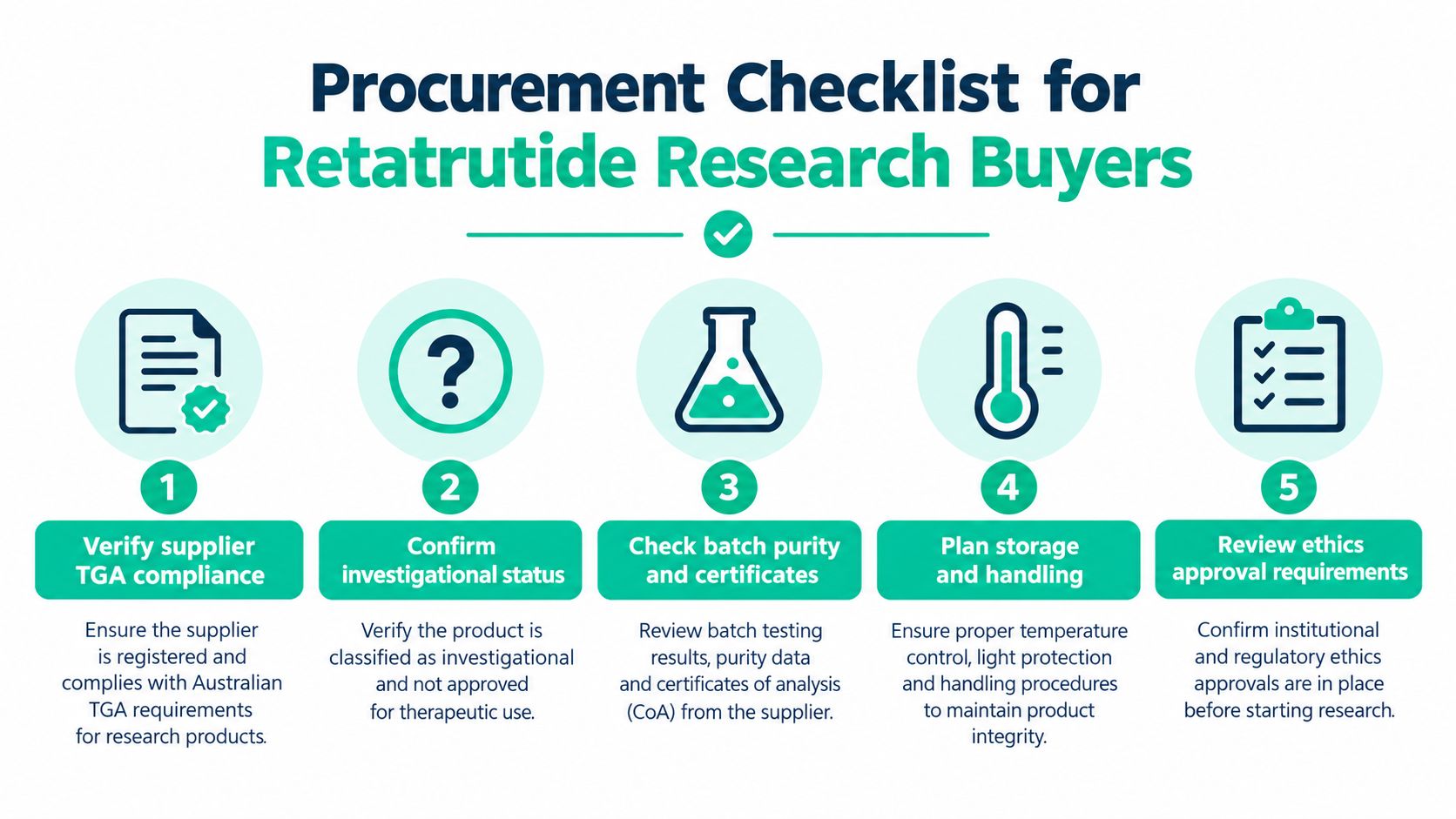
Practical supplier review points
Supplier review is usually less about sales claims and more about whether the paperwork can survive scrutiny. A useful comparison works like checking a chain-of-custody form. The question is not whether a listing looks polished. The question is whether the supplier can support the file your institution needs.
Ask for evidence on five points:
- Batch-specific COAs
- Specification sheets available before checkout
- Clear research-use-only labelling
- Australian support and domestic order processing details
- Standardised vial formats that support repeatable study setup
A factual example helps here. Bulk Aussie Peptides is presented as an Australian supplier of research-use-only peptides with online catalogue access, batch documentation support, domestic processing, and standardised bulk vial formats that may fit institutional procurement review.
Final procurement position
The conservative position is usually the correct one. Retatrutide should sit inside controlled research purchasing, with documented review before the vial enters the building.
Products are supplied strictly for laboratory research purposes only. They are not for human consumption, therapeutic use or diagnostic procedures.
If your team is assessing retatrutide for laboratory work, Bulk Aussie Peptides provides research-use-only peptide catalogue access, standardised vial formats and batch documentation support relevant to Australian procurement workflows. Review the available specifications and COA materials before ordering so your file is ready for receiving, biosafety and reproducibility checks.