
Buy BPC 157 for Research Use in Australia Guide
You're usually at the same point when you search buy BPC 157. You've got a research need, a protocol to satisfy, and a procurement trail to protect, but the market around this peptide is noisy and full of casual retail language that doesn't match Australian laboratory reality. The right question for an Australian lab isn't whether you can treat BPC-157 like an over-the-counter item. It's whether you can source it with enough documentation, traceability, and research-only framing to pass governance, import, and audit scrutiny.
For Australian teams, the answer is straightforward. BPC-157 is not approved for human therapeutic use, it's not in the ARTG, and the TGA has placed it in Schedule 4 and Appendix D of the Poisons Standard, so possession without authority is illegal in the human-use context TGA news on peptides and social media. That means procurement should be treated as a compliance workflow, not a retail checkout.
Products are supplied strictly for laboratory research purposes only. They are not for human consumption, therapeutic use or diagnostic procedures.
Table of Contents
- Introduction to Buying BPC 157 for Laboratory Research
- What BPC 157 Is and How Research Teams Use It
- How to Evaluate Suppliers Before You Buy BPC 157
- Ordering BPC 157 Through Bulk Aussie Peptides
- Receiving and Verifying Your BPC 157 Batch Documentation
- Practical Tips for Handling Calculations and Storage
Introduction to Buying BPC 157 for Laboratory Research
If you're trying to buy BPC 157 for an Australian laboratory, start with procurement controls, not product marketing. Treat the compound as a research-only peptide, and base the purchase on documentation, batch traceability, and governance. The supplier should be able to show what is in the vial, identify the lot, and provide paperwork that stands up in your file.
The TGA's position sets the boundary. BPC-157 is not approved for human therapeutic use, it is not on the ARTG, and the final scheduling notice places it in the national poisons framework rather than an ordinary retail or pharmacy supply chain TGA final decisions notice. For Australian laboratories, the procurement request should state in-vitro or preclinical research only, and the supplier's batch paperwork should be checked before sign-off.
Practical rule: if the product page reads like a consumer supplement listing, treat it as a red flag until the documentation trail is clear.
This guide follows the sequence a lab manager should use. First, identify what the compound is and how researchers use it. Then compare suppliers on documentation, provenance, and batch verification. After that, check the ordering flow in a compliant Australian research context, and finally confirm the paperwork that should arrive with the shipment.
The common error is treating Schedule 4 like standard prescription availability. The TGA's public material places BPC-157 inside the unapproved therapeutic good and poisons framework for human-use settings, while also warning against unapproved peptide products more broadly TGA final decisions notice. That is the procurement line. If the intended use cannot be stated clearly as research-only, stop the purchase.
What BPC 157 Is and How Research Teams Use It
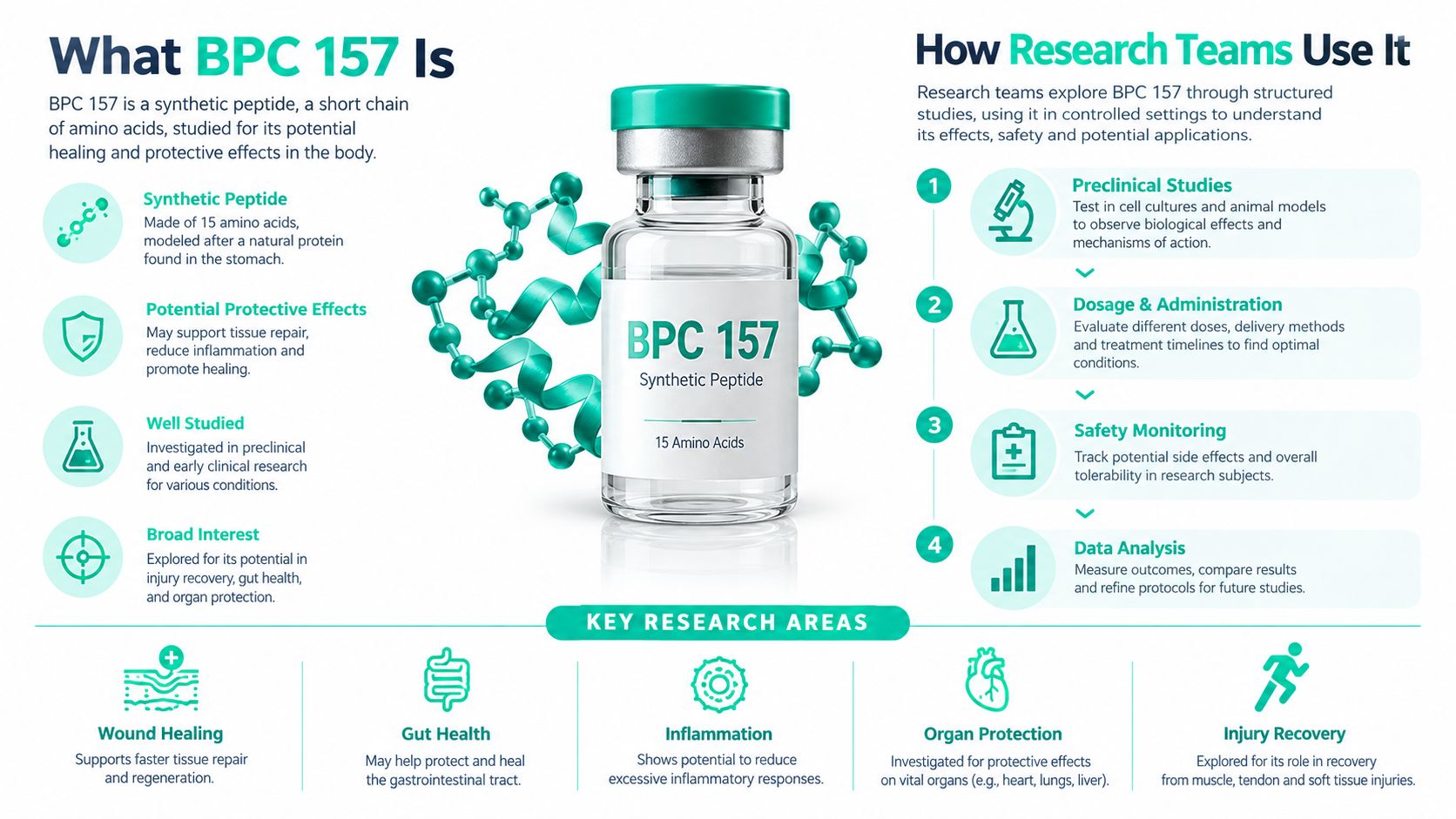
A procurement file for BPC-157 should start with identity, not marketing copy. The compound is a 15-residue synthetic peptide with the molecular formula C62H98N16O22 and molecular weight 1419.5 g/mol. Those details make bench-level checks possible, from label matching to molar calculations, and they should line up with the supplier record before anyone approves the order PubChem compound record. If the page cannot match those basics, do not buy it.
Identity first, claims second
Research teams use BPC-157 as a preclinical compound. A recent Australian research guide describes it as supplied strictly for in-vitro and preclinical research use and says it has no approved human therapeutic indication JCSG BPC-157 research guide. That is the right framing for Australian labs. It keeps assay design and model work separate from any human-use language, which does not belong in a research procurement request.
The check is simple. Can the supplier tie the item to a named compound, a stated quantity, and a batch or lot identifier that matches the certificate? If the answer is no, the file is incomplete. A catalogue entry that cannot be linked back to a specific record is not ready for sign-off.
Why researchers look at it
BPC-157 has been investigated in gastrointestinal, musculoskeletal, and broader preclinical repair contexts. That wording matters. It keeps the compound in the research category and avoids treating exploratory work as a treatment claim.
A laboratory spec sheet should use standard terms. Look for peptide identity, expected molecular mass, format, and any stated analytical basis for release. If you are reviewing a quote or a product page, the language should stay in the research lane. It should also stay compatible with a compliant Australian workflow, which is why a direct reference such as the BPC-157 research page is useful when comparing catalogue details with protocol requirements.
What to look for on a specification sheet
- Compound identity: The listed name should be BPC-157, with a structure or sequence reference if provided.
- Molecular data: 1419.5 g/mol is the reference point for identity and preparation maths.
- Use statement: The supplier should clearly state research use only.
- Documentation trail: The page should point you to batch-specific paperwork, not generic marketing copy.
Procurement teams should treat these checks as the baseline. If the identity, batch linkage, and use statement do not hold together, the product is not suitable for a research purchase.
How to Evaluate Suppliers Before You Buy BPC 157
Supplier choice should be judged on evidence, not branding. For Australian labs, the key test is whether the vendor can support a documented, research-only purchase with batch traceability and clear testing terminology. Anything less creates avoidable risk for procurement, ethics review, and internal audit.
What a serious procurement review should check
A supplier that's worth considering should be able to separate manufacturer-provided documentation from independent testing, identify the relevant lot or batch, and show where the paperwork lives. That matters because a generic quality claim tells you almost nothing about the specific vial on your desk. A lot-linked document tells you which batch was tested, how it was described, and whether the record matches the item you're buying.
The TGA's warning posture also matters here. Australian coverage now places BPC-157 alongside other unapproved peptides that are being actively warned against, which means procurement staff should expect more scrutiny rather than less TGA warnings on peptides. That makes source labelling and traceability more than a nice-to-have. They're part of the approval chain.
Practical rule: a product description without a batch number is not documentation, it's advertising.
Supplier Evaluation Checklist for Research Grade BPC 157
| Criterion | What to Verify | Why It Matters |
|---|---|---|
| Research-only wording | The supplier states laboratory research use only | Prevents human-use ambiguity in procurement records |
| Batch traceability | SKU, lot number, and vial label all match | Lets you tie the item to the correct CoA |
| Testing transparency | The page distinguishes manufacturer-provided from independent testing | Helps you judge evidence quality |
| Analytical detail | Identity and purity are described in usable laboratory terms | Supports internal verification and protocol review |
| Documentation access | CoA or batch documentation is available before or at purchase | Needed for audit and governance files |
| Australian handling | Domestic support, processing, and shipping terms are clear | Reduces avoidable delays and import confusion |
For teams that want a deeper review process, the Testing and Quality page is the place to inspect how the documentation language is presented before anyone commits budget.
Common mistakes that waste time
One mistake is assuming Schedule 4 means ordinary prescription availability. The TGA material doesn't support that reading for this compound in human-use settings. Another is accepting a purity claim without asking what lab generated it and whether the report is tied to the exact lot in hand. A third is treating a “research use only” disclaimer as proof of legitimacy. It isn't. It only tells you the seller knows the product sits outside normal consumer medicine pathways.
Good procurement teams ask for batch-specific evidence up front. They also ask whether the paperwork is independent, manufacturer-provided, or still pending. That simple distinction saves a lot of back-and-forth once the request reaches governance.
Ordering BPC 157 Through Bulk Aussie Peptides
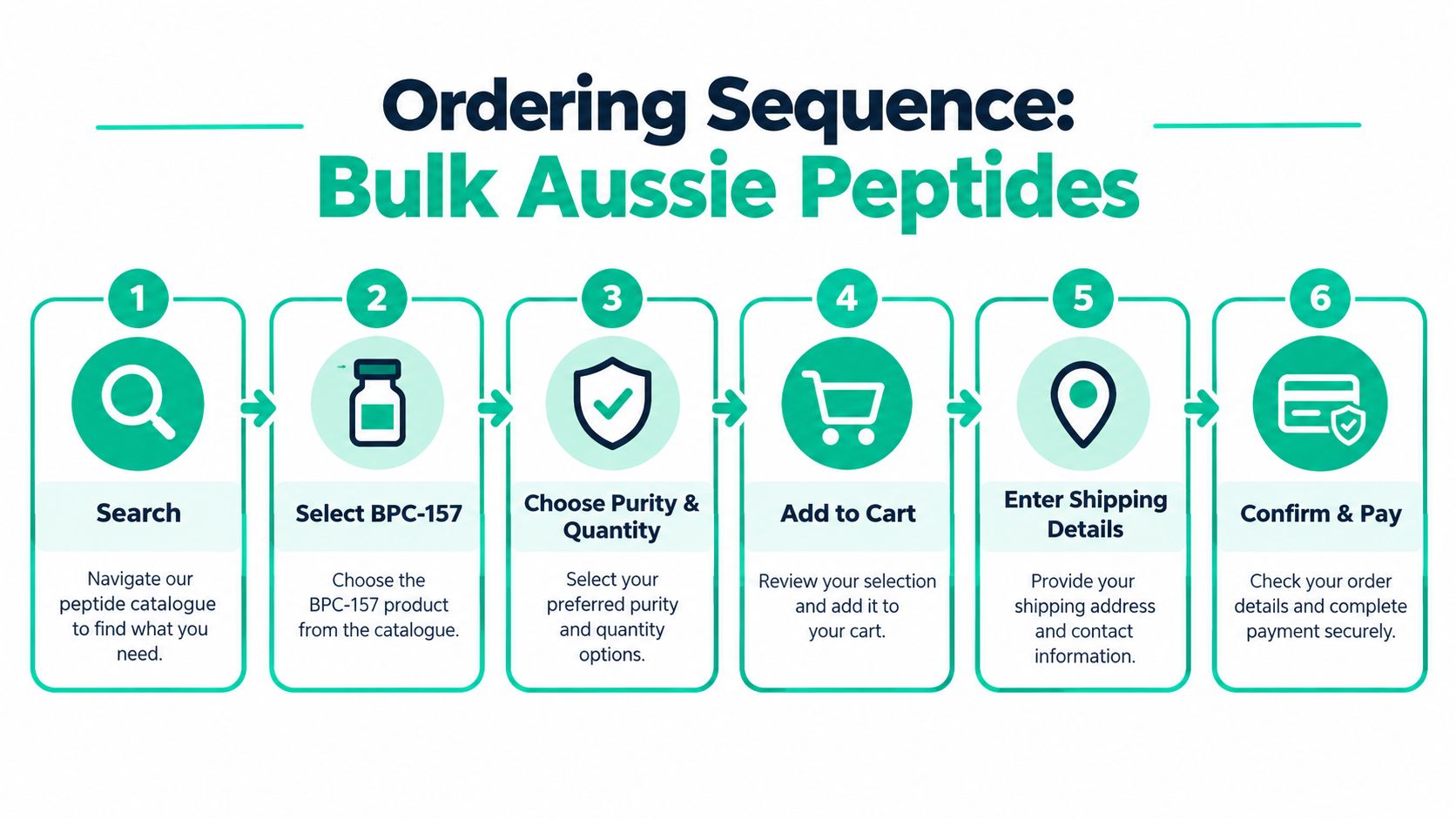
The cleanest way to handle ordering is to keep it inside a laboratory procurement flow. On Bulk Aussie Peptides, that starts with the research catalogue, where you select BPC-157 in a 10-pack vial format designed for consistent batch handling across a study set. For teams running repeat assays, that format is useful because it reduces the chance of mixing lots across a protocol.
Before you add anything to cart, review the product specifications. Look for the stated analytical information, the lot or batch reference, and the documentation language attached to the page. Bulk purchasing only helps if the paperwork is strong enough to support the order file.
The order flow that actually makes sense
Start by selecting the compound in the catalogue, then confirm the vial configuration and the documentation available on the page. After that, use the peptide concentration calculator to check the maths for your assay plan, because the right concentration range is a protocol decision, not a checkout decision.
From there, move to secure checkout with Australian business billing details. Domestic processing and tracked shipping are part of the workflow for Australian labs, which keeps the order aligned with local procurement expectations rather than offshore retail habits. The business also publishes a standard dispatch window of 1–3 business days and notes Australia-wide delivery, with free shipping thresholds over $500 AUD Bulk Aussie Peptides shipping and fulfilment information.
What to check before payment
- Catalogue match: Confirm the item is BPC-157, not a blended or unrelated research peptide.
- Format: Make sure the vial count and package size match your purchase request.
- Documentation: Review lot-linked paperwork before you finalise the order.
- Billing details: Use the correct business or institutional information.
- Study fit: Check the concentration plan before the order is locked in.
If your team needs a single supplier option that keeps ordering and documentation together, Bulk Aussie Peptides is positioned around research-only peptide supply, batch paperwork, and domestic fulfilment. That doesn't replace your own checks, but it does mean the procurement path is built around the kind of evidence Australian labs need.
Receiving and Verifying Your BPC 157 Batch Documentation
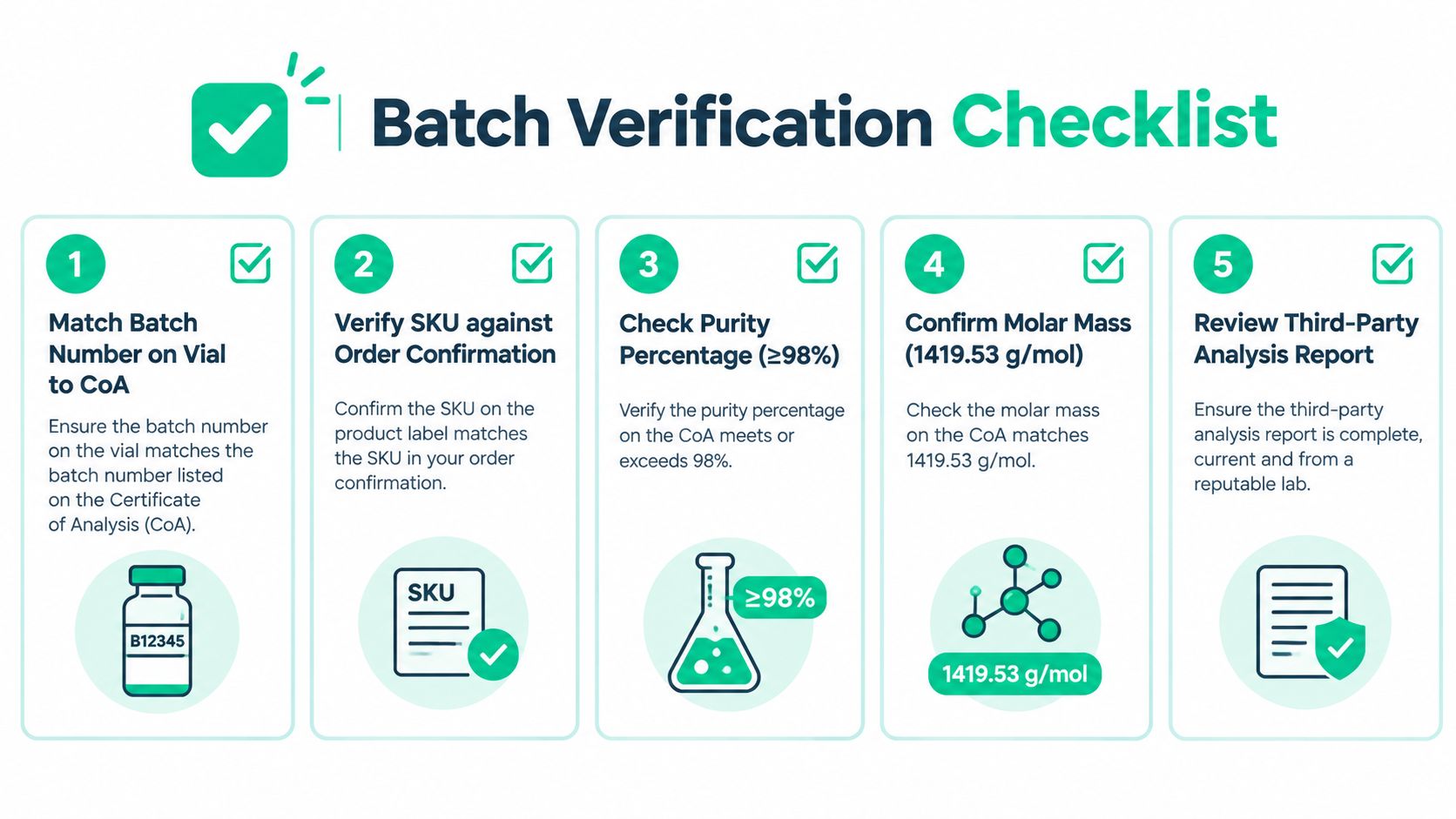
Once the package arrives, the job isn't done. The first task is to close the traceability loop by matching the batch number, SKU, and certificate of analysis to the vial in front of you. If those three items don't line up, don't file the material as ready for use.
What the verification file should contain
The COA library should be your first stop if you need to confirm the lot record. File the batch identifier, supplier invoice, specification sheet, and any third-party report together so the record stays auditable. Keep the version of the paperwork that corresponds to the item received, not a generic document from a previous order.
The key distinction here is between manufacturer-provided documentation and independent laboratory testing. They are not the same thing. A manufacturer's sheet can support traceability, but it doesn't carry the same weight as an external report when a committee or auditor asks where the numbers came from.
Retain the lot-linked paperwork in the same folder as the purchase order. If you split the files, someone will eventually lose the chain.
What to match before the vial is used
- Batch number on vial: Match it against the CoA and invoice.
- SKU on order confirmation: Confirm it's the same product code.
- Identity data: Check the molecular mass reference against the product spec.
- Purity statement: Read it as a batch result, not a universal promise.
- Third-party status: Record whether the report is independent, manufacturer-issued, or both.
The useful internal question is not whether the certificate looks impressive. It's whether a person outside the procurement team could reconstruct the purchase from the file alone. That's the standard worth aiming for in a university, CRO, or biotech environment.
If there's a gap, flag it before the vial enters the study workflow. That protects ethics submissions, keeps the inventory clean, and avoids a later argument about whether the material was properly documented.
Practical Tips for Handling Calculations and Storage
Keep the maths neutral and the storage logic simple. For in-vitro work, the main questions are diluent selection, gentle reconstitution, and volume-to-concentration calculation, not treatment planning. Standard lab practice is to use a suitable sterile diluent, introduce it slowly down the vial wall, and avoid aggressive agitation that can stress the peptide material.
The calculation side is where teams lose time. Use the concentration calculator to convert vial size and diluent volume into a usable concentration for your assay plan, then record the result in the worksheet before any preparation starts. That avoids transcription errors and keeps the preparation notes consistent across staff members.

A short handling checklist
- Confirm the purpose: Mark the item as laboratory research only in the file.
- Check the diluent: Use a sterile laboratory diluent appropriate for the assay.
- Mix gently: Let the liquid run down the vial wall rather than striking the cake directly.
- Record the maths: Save the concentration calculation with the batch paperwork.
- Store consistently: Follow the product's stated storage guidance and keep it with the label record.
Storage should be handled as a documentation issue as much as a physical one. The vial, the label, and the paperwork should tell the same story. If they don't, stop and resolve the mismatch before anyone starts the assay.
Bulk Aussie Peptides provides research-only peptide supply with batch documentation, product specifications, and Australian order processing for teams that need a procurement trail they can defend. Review the available batch documentation, check the product specifications, and then buy BPC 157 only if your study file is already set up for research-only handling. Visit Bulk Aussie Peptides to compare the catalogue against your lab's documentation requirements before you order.