
Peptide Reconstitution Calculator Explained for Labs
You've just received a lyophilised peptide vial, the batch documentation is open, and the protocol requires a known working concentration. The arithmetic looks short, but a misplaced decimal or a misunderstood syringe scale can make the preparation record difficult to audit. A peptide reconstitution calculator helps convert vial mass and diluent volume into a clearly documented concentration and laboratory draw volume, but it can't replace identity checks, aseptic handling, labelling or storage controls.
Table of Contents
- Introduction to the Peptide Reconstitution Calculator
- Core Formulas Behind Peptide Concentration Calculations
- How to Use the Calculator Step by Step
- Unit Conversions and Syringe Measurements Explained
- Worked Examples for Common Vial Sizes and Diluent Volumes
- Common Pitfalls and How to Avoid Calculation Errors
- Aseptic Preparation Labelling and Storage Principles
- Quick Reference Glossary and Cross Referenced Resources
Introduction to the Peptide Reconstitution Calculator
A vial arrives with its batch record, product specification and planned diluent volume. The arithmetic may fit on one line, yet two conversion errors can undermine the record: reading milligrams as micrograms or treating syringe units as millilitres. A peptide reconstitution calculator helps organise those inputs into concentration, research draw volume and, where the syringe calibration is known, syringe units.
The calculator uses the peptide mass in a vial and the volume of diluent added. Its primary result is usually milligrams per millilitre. For example, a 10 mg vial in 2 mL gives 5 mg/mL, while the same vial in 5 mL gives 2 mg/mL. The mass has not changed. The added volume has, so the concentration changes. The wider Australian calculation context is covered in this Australian peptide reconstitution guide.
Keep the calculation beside the laboratory controls. Record the vial identity and lot details, confirm the diluent and its volume, use sterile handling appropriate to the approved laboratory procedure, then label the prepared solution with the calculated concentration, preparation details and storage requirements. The calculator supplies arithmetic. It does not supply an aseptic technique or a complete audit trail.
This article addresses neutral laboratory mathematics, concentration calculations, storage principles and documentation interpretation. It does not provide medical advice, human dosing, administration, injection or treatment guidance. Quantities below are mathematical examples for research preparation and verification, not recommendations for human use.
Laboratory scope: Products are supplied strictly for laboratory research purposes only. They are not for human consumption, therapeutic use or diagnostic procedures.
Why the tool matters in an Australian lab
Australian research teams may use calculation templates for vial sizes, diluent volumes and syringe conversions. Australian-focused tools published by research suppliers include formulas for concentration, draw volume and syringe units, with presets such as 5 mg, 10 mg, 15 mg, 20 mg, 30 mg and 50 mg. That format is described in the Australian peptide calculator tools collection.
A consistent worksheet lets a lab manager compare the calculation with the vial label, check the batch record and reproduce the same working stock across a study. It also makes review easier because the input units, formula and final syringe conversion remain visible. The calculator belongs inside that documented workflow, not as a standalone dose-conversion widget.
What the calculator can and can't confirm
It can calculate concentration from stated inputs and determine a required volume from a target concentration or target mass, provided the units match. It cannot confirm peptide identity, molecular integrity, sterility, diluent compatibility, storage history or the validity of supplier documentation.
Before approving a result, compare the vial quantity and product identity with the relevant specification sheet and batch record. Treat a manufacturer-provided Certificate of Analysis as manufacturer documentation, not automatically as independent laboratory testing.
Core Formulas Behind Peptide Concentration Calculations
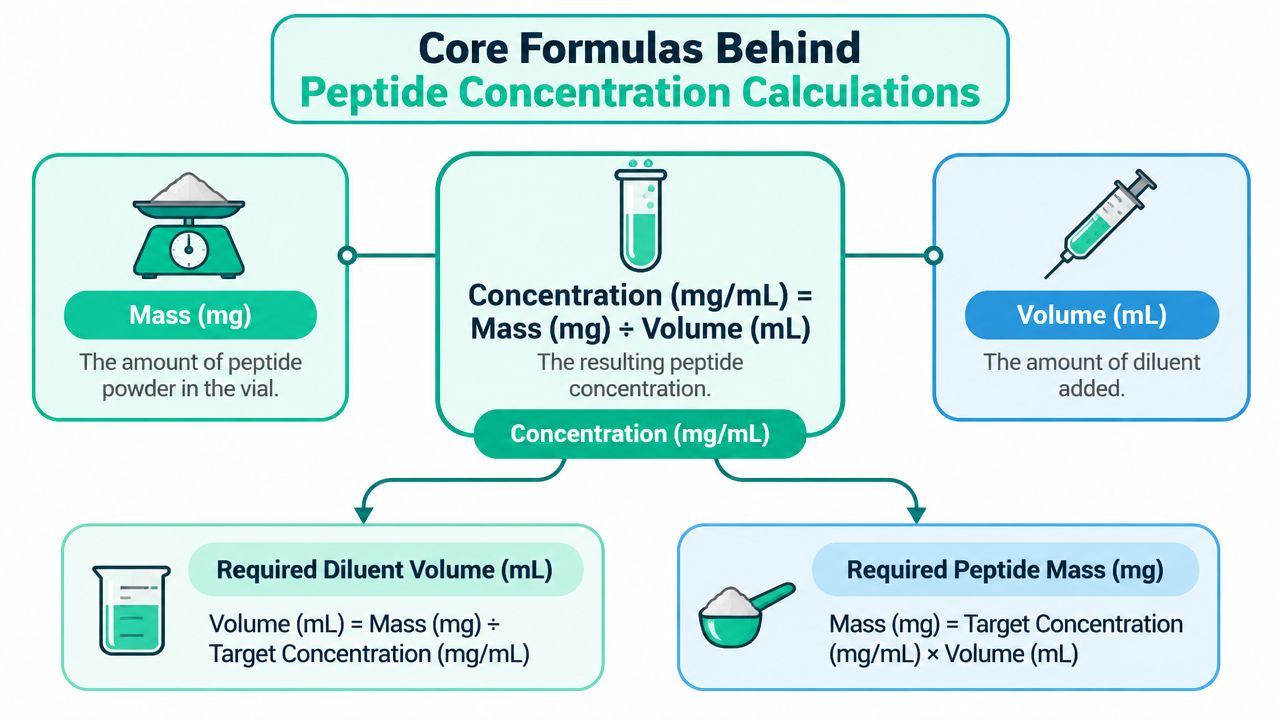
Every reconstitution calculation begins with one relationship:
Concentration (mg/mL) = peptide mass (mg) ÷ diluent volume (mL)
The formula works because it describes how much peptide is present in each millilitre of the prepared solution. If the mass stays constant and the volume increases, the concentration falls. If the volume decreases while the mass stays constant, the concentration rises.
Rearranging the relationship
The same formula can answer different preparation questions. If you know the peptide mass and the concentration you want, rearrange it as:
Required diluent volume (mL) = peptide mass (mg) ÷ target concentration (mg/mL)
If you know the target concentration and the volume available, use:
Required peptide mass (mg) = target concentration (mg/mL) × volume (mL)
These forms are useful when a protocol specifies a working stock rather than a particular volume of diluent. They also let a procurement reviewer check whether a proposed preparation is mathematically consistent with the stated stock concentration.
Calculating a draw volume
Once concentration is known, calculate the solution volume for a research quantity:
Draw volume (mL) = target mass (mg) ÷ concentration (mg/mL)
You can use micrograms instead, but the numerator and denominator must use compatible units. For example, a target stated in micrograms should be divided by a concentration stated in micrograms per millilitre, or the target must first be converted into milligrams.
The concentration rule is also the primary step identified in the Australian laboratory concentration calculator. Keeping that first step visible in a worksheet makes the final result easier to review than recording only a syringe-unit number.
Connecting volume with syringe units
For a U-100 syringe, 100 units equals 1 mL, so 0.01 mL equals 1 unit. A volume in millilitres can therefore be converted as:
Syringe units = volume (mL) × 100
The syringe unit is a volume indication, not a mass indication. The mass represented by one unit depends on the concentration already calculated. A different vial mass or a different diluent volume changes the concentration, which changes the mass represented by every syringe graduation.
How to Use the Calculator Step by Step
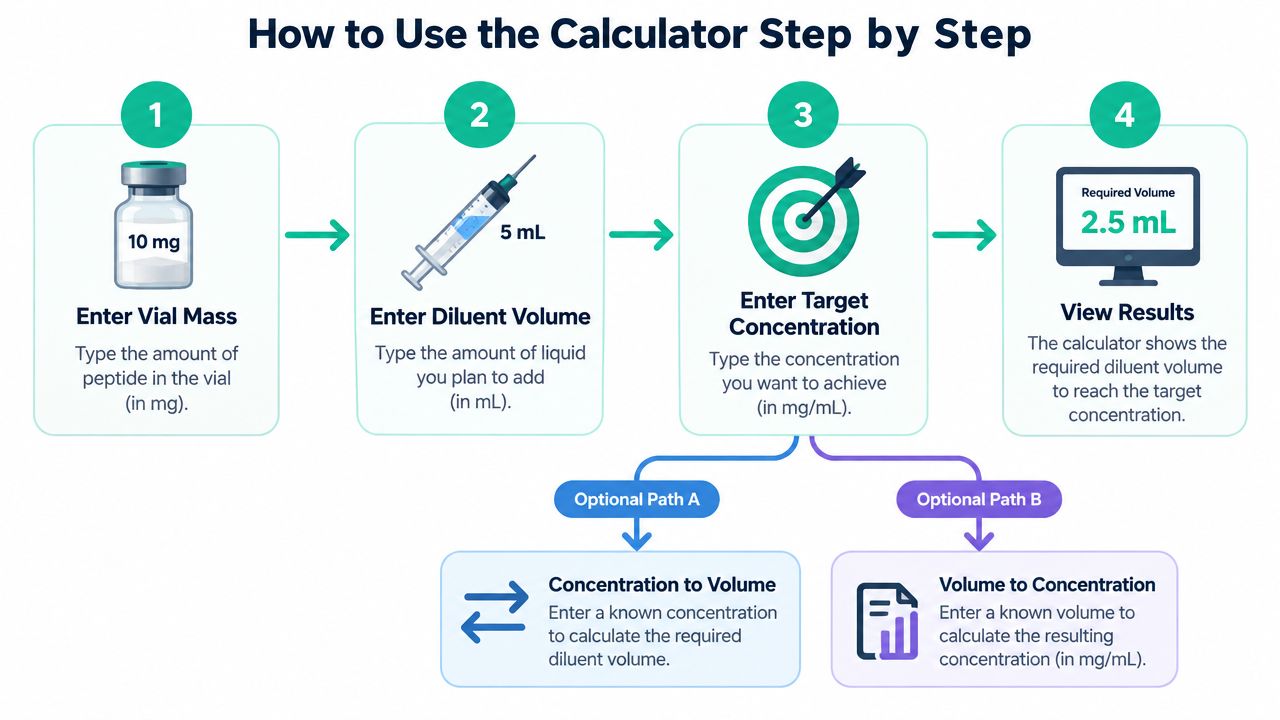
A correct result starts with an auditable record. Read the vial label and approved preparation worksheet, then enter those values into the calculator. Australian-oriented workflows may use 1 mL, 2 mL or 3 mL of diluent. The selected volume must match the laboratory method, container capacity and actual preparation. Do not treat 2 mL as an automatic default. Record why the chosen volume was used, especially when the preparation will be reviewed later.
Enter the vial mass
Copy the peptide quantity printed on the vial or confirmed in the batch documentation. Select a preset only when it matches the vial. Otherwise, enter the exact value manually. The product name, pack format and a previous preparation are not substitutes for the documented mass.
The calculator treats this entry as the total peptide mass in the vial. It does not verify assay value, purity, water content or molecular identity. Those checks belong in the batch and material records.
Enter the diluent volume
Enter the planned volume in millilitres before preparation. If the solution has already been prepared, use the measured volume added, not the intended worksheet value. The difference affects concentration, so write the actual volume beside the calculation and label the container accordingly.
Use the correct syringe calibration if the calculator requests it. A 0.3 mL, 0.5 mL or 1.0 mL syringe can have a different barrel capacity, while its unit scale still depends on the stated calibration. Confirm the scale printed on the syringe rather than selecting one from memory.
Choose the calculation direction
Identify whether the calculator expects a target concentration or a target mass. Some tools return the required solution volume, while others calculate concentration from the vial mass and diluent volume. Check the input and output labels before transferring any result to the worksheet.
Possible outputs include:
- Concentration, usually in mg/mL and sometimes mcg/mL.
- Required solution volume, in mL.
- Syringe units, based on the selected calibration.
- Mass per graduation, when the tool provides it.
Treat the displayed answer as a calculation to review, not as an approval decision. Recalculate concentration manually as mass divided by volume, then check the mg-to-mcg conversion and syringe scale separately. A reviewer should be able to trace the vial, diluent, result, preparer and date from the record.
The video below provides a visual supplement to the calculator workflow.
Unit Conversions and Syringe Measurements Explained
A result can look reasonable while being wrong by a factor of 1,000 if the mass units are mixed. Milligrams, micrograms and nanograms measure mass. Millilitres and microlitres measure volume. Syringe units indicate a calibrated volume, so they do not represent a fixed peptide mass.
1 mg equals 1,000 mcg, and 1 mcg equals 1,000 ng. Convert the values to the same unit before comparing or dividing them. Record the units beside every number, including intermediate results.
Bench-side conversion table
| From | To | Conversion Factor | Example |
|---|---|---|---|
| mg | mcg | 1 mg = 1,000 mcg | 2 mg = 2,000 mcg |
| mcg | ng | 1 mcg = 1,000 ng | 2 mcg = 2,000 ng |
| mL | µL | 1 mL = 1,000 µL | 0.01 mL = 10 µL |
| U-100 units | mL | 100 units = 1 mL | 1 unit = 0.01 mL |
For the Australian U-100 convention, the peptide reconstitution calculator uses 100 units per 1 mL, making 1 unit equal to 0.01 mL. Verify that the syringe itself is marked U-100 before applying this conversion.
Units aren't mass
Two solutions can use the same U-100 syringe yet contain different peptide masses per unit. A unit is like a measured scoop of volume: the scoop stays the same size, while the amount of material inside changes with concentration. Calculate mass per unit by multiplying concentration by 0.01 mL, then retain a consistent mass unit.
U-50 and U-30 syringes use different calibrations. Do not transfer a U-100 result to either scale without checking the stated volume represented by one unit. If the calibration is unclear, stop and confirm it with the laboratory manager.
For an auditable workflow, write the conversion, syringe calibration and calculated volume on the worksheet before preparation. Label the vial with the concentration, diluent volume, date and preparer, then record storage conditions according to the approved laboratory method. This separates calculator output from the physical preparation and makes a unit error easier to detect during review.
Worked Examples for Common Vial Sizes and Diluent Volumes
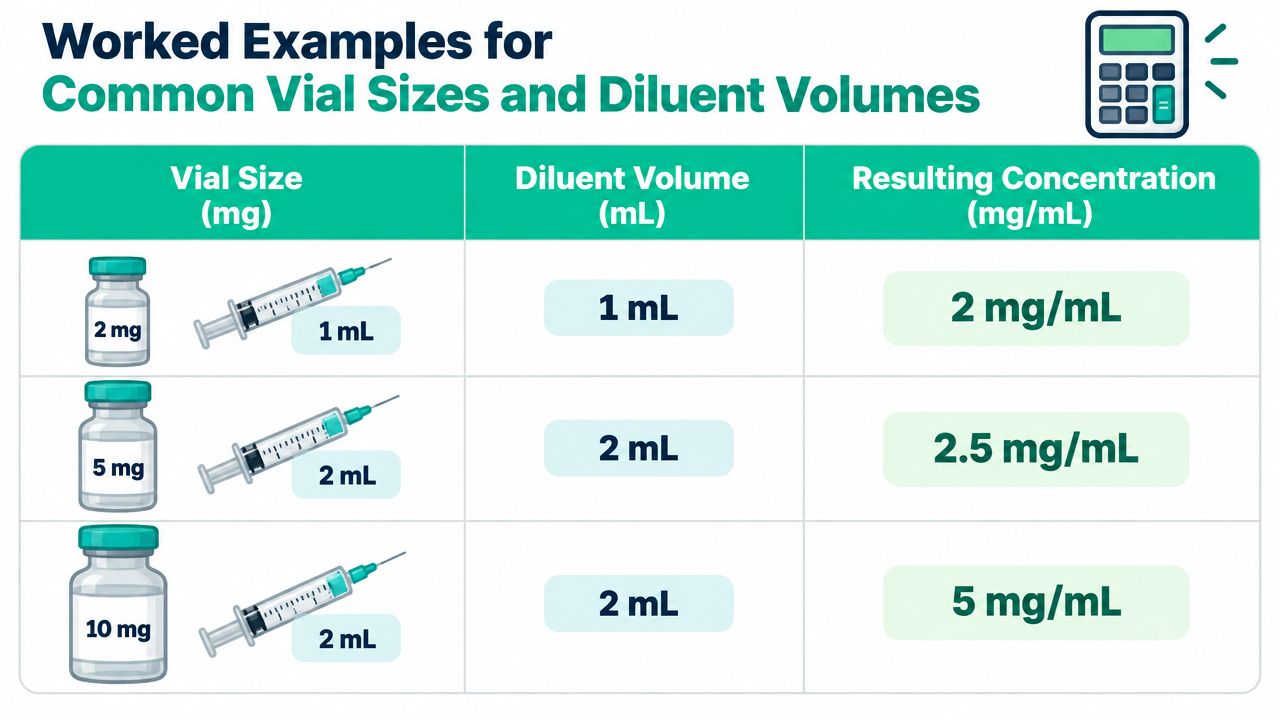
Worked examples are useful because they show how a small change in either vial mass or diluent volume changes the stock concentration. The figures below are mathematical examples based on standard Australian-oriented working formats, not instructions for human use.
Example one, 2 mg in 1 mL
Start with 2 mg of peptide mass and 1 mL of diluent.
2 mg ÷ 1 mL = 2 mg/mL
That concentration is also 2,000 mcg/mL. On a U-100 syringe, one unit is 0.01 mL, so the mass represented by one unit is:
2 mg/mL × 0.01 mL = 0.02 mg
Converting that result gives 20 mcg per unit. The important point is not the unit figure alone. It follows from the concentration and the syringe calibration.
Example two, 5 mg in 2 mL
For a 5 mg vial with 2 mL of diluent:
5 mg ÷ 2 mL = 2.5 mg/mL
That equals 2,500 mcg/mL. One U-100 unit contains:
2,500 mcg/mL × 0.01 mL = 25 mcg
A 250 mcg research quantity would therefore correspond mathematically to 0.10 mL, or 10 U-100 units. The calculation is included only to demonstrate conversion and must be applied within an approved laboratory method.
For compatible diluent information and handling context, consult the bacteriostatic water research guide.
Example three, 10 mg in 2 mL
For 10 mg in 2 mL:
10 mg ÷ 2 mL = 5 mg/mL
At that concentration, one U-100 unit contains:
5 mg/mL × 0.01 mL = 0.05 mg
That equals 50 mcg per unit. A 500 mcg research quantity would correspond to 0.10 mL, or 10 units on a U-100 syringe.
Example four, 10 mg in 5 mL
The same vial mass with a larger volume produces a different stock:
10 mg ÷ 5 mL = 2 mg/mL
The stock is now less concentrated than the 10 mg in 2 mL example. Every U-100 unit contains 20 mcg, because the volume per unit hasn't changed but the mass per millilitre has.
Common Pitfalls and How to Avoid Calculation Errors
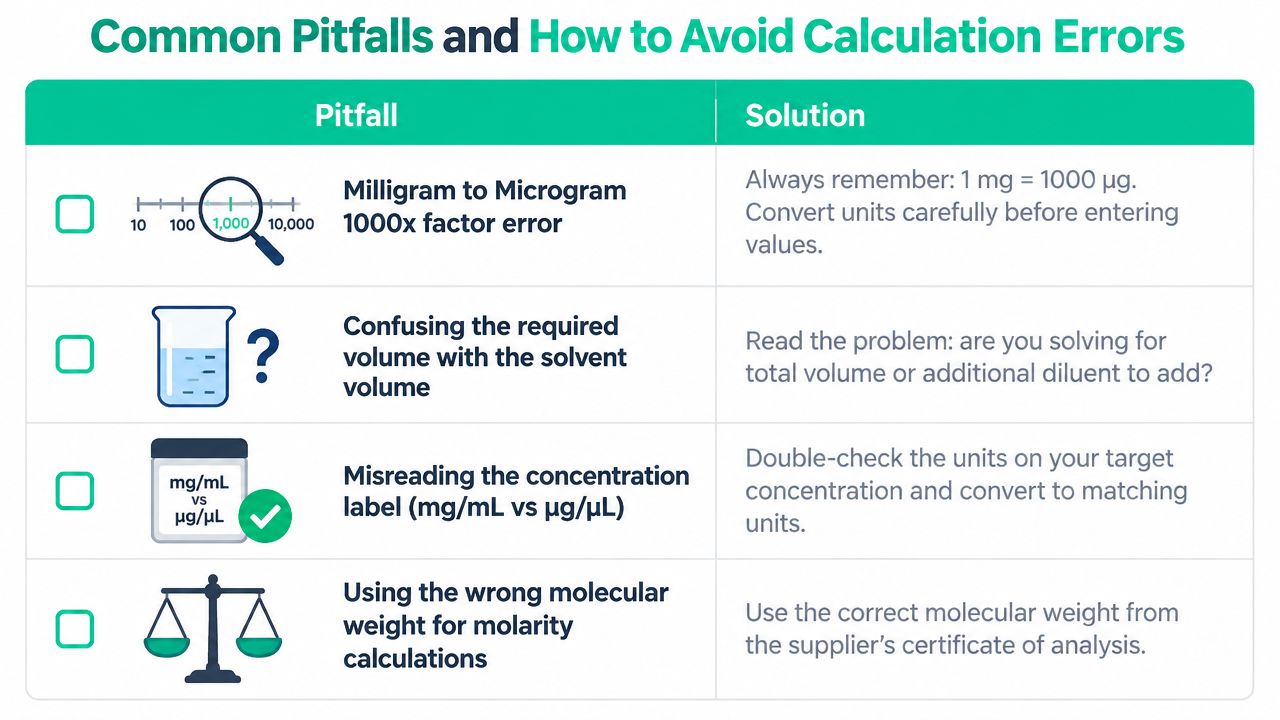
A researcher may read a vial label, enter the values into a calculator and draw the result without checking the units between steps. The two recurring failures are the milligram-to-microgram conversion error and treating a syringe unit as a fixed peptide mass. Both become easier to prevent when the calculation is written as an auditable chain, from vial identity through final draw volume.
The 1,000-fold unit shift
Lyophilised peptides are commonly labelled in milligrams, while working quantities may be expressed in micrograms or nanograms. 1 mg equals 1,000 mcg. Entering a milligram value into a microgram field therefore changes the result by a factor of 1,000. This relationship is also used in the Australian calculator context.
Write the unit beside every input before entering it. If the field expects mg, enter mg. If the target is in mcg, convert the relevant mass before calculating the draw volume. Treat the unit label like a checkpoint on a sample tube. It prevents a correct arithmetic operation from being applied to the wrong quantity.
The syringe-unit assumption
A U-100 unit measures volume. It does not represent a fixed mass of peptide. The mass per unit changes when either the vial mass or diluent volume changes, even though the syringe scale stays the same.
The calculator can perform the conversion from concentration to volume, but it cannot confirm that the vial identity, diluent volume or syringe calibration was entered correctly. Record those inputs beside the result rather than relying on the displayed number alone.
Verification checklist
Before approving the preparation record, check:
- Identity: Compound name, vial quantity, batch reference and supplier match the specification.
- Units: Mass, concentration and target quantity use compatible units.
- Volume: The calculation uses the actual diluent volume, not an assumed default.
- Calibration: Syringe type and unit scale are recorded.
- Arithmetic: Concentration equals mass divided by volume.
- Traceability: Calculator output is copied to the worksheet with date, operator and batch reference.
A second person should be able to reproduce the result from the record without guessing which conversion was used. This is the practical value of pairing calculator maths with lab documentation.
Practical rule: If the answer looks unexpectedly large or small, stop at the concentration step. Check the unit conversion and the mass-per-volume calculation before working in syringe units.
Molarity adds a separate check. It requires the correct molecular weight from the relevant certificate of analysis or specification record. Do not substitute a generic value recalled from memory.
Aseptic Preparation Labelling and Storage Principles
A numeric result doesn't make a preparation auditable. The researcher must also document how the vial was handled, what diluent was used, when the solution was prepared and where it was stored. Australian handling guidance emphasises aseptic technique and recommends disinfecting the vial septum, adding diluent slowly down the vial wall and avoiding vigorous shaking because frothing and aggregation can occur. That handling advice is set out in Australian peptide reconstitution best practices.
Preparation controls
Use the laboratory's approved aseptic procedure and compatible materials. Independent Australian guidance identifies bacteriostatic water as a compatible diluent in relevant workflows and warns against using tap water or saline as the primary diluent. Don't improvise a solvent choice because the calculator accepts a volume.
A practical preparation record should capture:
- Vial identity: Compound, stated mass, batch reference and supplier.
- Diluent identity: Name, lot information and expiry status where applicable.
- Handling record: Septum disinfection, addition method and operator initials.
- Appearance: Any relevant observation recorded according to the laboratory's approved inspection criteria.
- Calculation: Mass, volume, concentration and syringe calibration.
- Storage: Storage condition entered immediately after preparation.
Add the diluent slowly down the inside wall of the vial rather than directing force at the powder cake. Avoid shaking or vigorous agitation. If dissolution isn't immediate, allow the solution to stand briefly at room temperature according to the laboratory method, without treating temporary standing time as a universal stability rule.
Labelling and storage
Label the vial immediately with the calculated concentration, preparation date and storage condition. Australian handling guidance recommends refrigeration of reconstituted solutions at 4°C, but supplier guidance can vary on whether a prepared solution should be used within weeks rather than days. The laboratory's approved stability information and the compound-specific documentation should control the discard decision.
The peptide storage and stability guide can support general record preparation, but it doesn't replace validated stability data for a specific compound and formulation.
Documentation isn't the same as independent testing
A specification sheet, manufacturer-provided CoA and independent laboratory report are different document types. Record which one you reviewed. Don't describe a manufacturer-provided document as independent testing, and don't generalise one batch result to every batch.
Quick Reference Glossary and Cross Referenced Resources
Use this glossary at the bench, then check the relevant method or source document before approving a preparation. The aim is an auditable record: another trained researcher should be able to follow the units, verify the calculation and identify the handling conditions.
Core terms
- Reconstitution: Dissolving a lyophilised peptide powder in a selected liquid to create a research solution.
- Lyophilised: Freeze-dried material supplied as a dry powder.
- Peptide mass: The stated amount of peptide in the vial, usually recorded in mg.
- Diluent: The liquid added to the vial. The laboratory method must confirm its identity and compatibility.
- Concentration: The amount of peptide per unit volume, commonly expressed as mg/mL.
- Working stock: A prepared solution used for later laboratory measurements or assay preparation.
- U-100 syringe: A syringe scale where 100 units equals 1 mL and 1 unit equals 0.01 mL. Confirm this calibration before reading syringe units.
- Aseptic technique: Handling practices intended to minimise contamination during preparation.
- Certificate of Analysis: Batch-related documentation that may report identity, testing or other specifications. Record whether it came from the manufacturer or an independent laboratory.
- Molecular weight: The compound-specific value required to convert mass concentration into molar concentration.
Formula summary
Keep these relationships visible in the worksheet:
| Calculation | Formula |
|---|---|
| Concentration | Mass (mg) ÷ volume (mL) |
| Required volume | Mass (mg) ÷ target concentration (mg/mL) |
| Required mass | Target concentration (mg/mL) × volume (mL) |
| U-100 units | Volume (mL) × 100 |
For rapid verification, run the concentration calculation in the site calculator, then compare its result with a manual calculation. The calculator should support review, not hide a conversion error. Check the mg-to-mcg conversion separately, and confirm that any syringe-unit reading matches the syringe calibration.
Resource map for research teams
- Compound terminology: Use a compound glossary to confirm names, synonyms and research context before procurement.
- Research background: Consult a research library for high-level context, distinguishing in-vitro, animal and preclinical evidence from human research.
- Testing review: Check Testing and Quality information to identify whether documentation is manufacturer-provided, independently generated, pending or unavailable.
- Batch records: Search the CoA library for the relevant batch rather than relying on an unrelated document.
- Procurement planning: For repeat studies, review bulk research supply information and confirm pack format, documentation and quotation requirements before ordering.
Bulk Aussie Peptides supplies research-use-only peptides and associated laboratory supplies, including standardised 10-pack vial formats, product specifications and batch documentation for procurement review. Visit Bulk Aussie Peptides to review the research catalogue and connect the selected material with a documented concentration and preparation workflow.